
Hybrid vs. In-Person MFT Programs in California: Which Is Right for You?
Hybrid vs. In-Person MFT Programs in California: Which Is Right for You?
If you are researching Marriage and Family Therapy (MFT) programs in California in 2026, you will almost certainly encounter both hybrid and fully in-person options. Which format is right for you depends on what you actually need: clinical training quality, scheduling flexibility, geographic access, and whether the program's approach to supervised practice matches your learning style. Neither format is inherently superior. Both can prepare graduates for California BBS licensure, and both have genuine tradeoffs. The meaningful question is not hybrid versus in-person in the abstract, but which specific program uses its format effectively to develop your clinical skills. This post reviews the current research on technology-enabled supervision, explains how the California BBS regulates hybrid training, addresses common concerns prospective students raise, and provides a framework for evaluating any program you are considering, regardless of format. For a structured way to compare programs side by side, browse our directory of MFT programs in California.
Last updated: September 2026
What Is the Difference Between Hybrid and Fully In-Person MFT Programs?
A fully in-person MFT program requires students to attend classes, supervision, and practicum activities at a physical campus location. A hybrid program distributes some or all instructional and supervisory components across both synchronous online formats and in-person requirements. The term "hybrid" covers a wide range of structures: some programs conduct the majority of coursework online while requiring a residential intensive period; others keep clinical supervision in person while delivering didactic content via videoconference; still others are fully synchronous online with no required on-campus attendance.
What this means practically is that "hybrid" is not a single model. Before comparing programs, it is worth asking each program to specify exactly which components are online versus in-person, whether supervision can be conducted via videoconference under California BBS regulations, and how practicum placement is coordinated for students in different geographic regions of California. Understanding the full scope of California MFT licensure requirements can help you evaluate what each format must deliver.
The California BBS has expanded its acceptance of videoconference-based supervision in recent years. Its Telehealth Committee has worked specifically on the framework for supervision via videoconferencing, and current regulations permit triadic and group supervision by HIPAA-compliant videoconferencing. This regulatory evolution means that the policy barrier that once made hybrid supervision hours more complicated has substantially decreased for California students.
Can You Get the Same Clinical Training Quality in a Hybrid MFT Program?
This is the question prospective students most commonly ask, and the research provides a nuanced but generally encouraging answer. The quality of clinical training in any format depends far more on the specific training methods a program uses than on whether courses are delivered in a physical room or via video.
A critical distinction worth understanding is the difference between passive learning and skills training. Research on psychotherapy training consistently finds that didactic instruction alone produces limited skill acquisition. As Tony Rousmaniere, PsyD, and Alexandre Vaz, PhD, have noted, "many graduate programs produce students who can talk or write about therapy quite adeptly yet still struggle to perform therapy optimally. This gap is precisely what deliberate practice aims to fill by consolidating declarative knowledge into procedural skill" (Rousmaniere & Vaz, 2025, p. 3). If a program, whether in-person or hybrid, relies primarily on lecture and case discussion without structured behavioral rehearsal, the format is unlikely to drive deep clinical skill acquisition regardless of how many hours students spend in a classroom.
The strongest evidence on training quality focuses on what happens during supervision and skills training, not on the physical container in which those activities occur. A 2025 case study published in the Journal of Clinical Psychology documented how a structured, video-integrated supervision model produced measurable improvement in both a trainee's clinical skills and a client's outcomes over nine sessions, with the client's suicidal ideation changing from "sometimes" to a steady "rarely" across the course of treatment (Brand, Miller-Bottome, Vaz, & Rousmaniere, 2025, p. 10). That kind of outcome-linked training does not require students to be in the same room as their supervisor.
What Does the Research Say About Technology-Enabled Supervision and Training?
The academic literature on technology-assisted supervision and training (TAST) has grown substantially over the past two decades. By July 2013, a literature review had already identified 49 publications with a significant focus on Internet-based TAST published between 2000 and 2013 (Rousmaniere, 2014, p. 216). Of those, 26 were original research studies. That body of literature has only expanded since then.
Early research found that videoconference supervision could maintain working alliance quality equivalent to in-person formats. The technology infrastructure that once limited videoconferencing quality has also dramatically improved. By early 2012, average global Internet speeds were already described as five times greater than the threshold recommended for good quality videoconferencing (Rousmaniere, 2014, p. 218), and connectivity has improved substantially in the decade since.
Large-scale implementations have also demonstrated feasibility at scale. The China American Psychoanalytic Alliance, for example, used videoconference to connect a pool of 400 Western clinical experts with 160 Chinese students across 18 cities (Rousmaniere, 2014, p. 219). These are not small pilot projects; they are operational training systems that have run for years.
Writing in the Wiley International Handbook of Clinical Supervision, Tony Rousmaniere, PsyD, described the regulatory and ethical landscape of TAST as resembling "the old 'Wild West': a vast, unregulated field, full of exciting potential to improve clinical supervision, being eagerly explored by early pioneers but also posing significant hazards" (Rousmaniere, 2014, p. 215). That characterization, written in 2014, reflects the genuine complexity that existed at the time. California's BBS has since developed clearer frameworks for videoconference supervision, making the landscape more navigable for both programs and students.
Rousmaniere later argued that the field needed to move past a defensive framing of the issue: "Rather than questioning whether TAST is 'as good' as traditional supervision, supervisors and researchers are encouraged to instead ask, 'What is now possible, and how can it serve my supervisees and their clients?'" (Rousmaniere, 2014, p. 232). That reframe from defensive comparison to productive possibility is a useful one for prospective students evaluating programs as well. Students interested in how supervision quality varies across programs may also want to read about how to evaluate MFT supervision quality.
How Do Hybrid MFT Programs Handle Practicum Supervision?
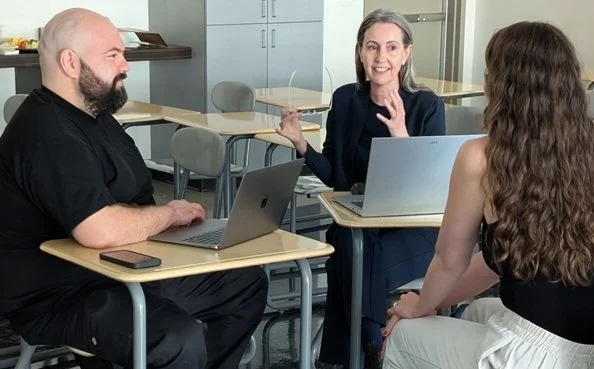
Practicum supervision is typically the component prospective students are most concerned about in hybrid programs, and for good reason. Supervision is where clinical skill development either accelerates or stagnates, and the structure of that supervision matters enormously. Students weighing the differences between MFT and LCSW pathways should note that supervision requirements differ across license types, and the format question applies to both.
The California BBS requires MFT candidates to accumulate 3,000 hours of supervised experience, with a minimum of 1,750 hours in direct client contact and specific ratios for individual and group supervision. Within those requirements, the modality of supervision (in-person versus videoconference) is increasingly flexible, provided that confidentiality standards are met and the program's supervision meets BBS standards.
What to ask any hybrid program you are considering is not simply whether supervision is videoconference or in-person, but how supervision is structured. Hanna Levenson, PsyD, a psychotherapy training expert with over 40 years of experience training more than 2,000 graduate students, observed after spending a year and a half reviewing the supervision practices of one deliberate practice-based program that "The supervisor isn't doing the training; the skill rehearsal is doing the training" (as reported in Levenson, 2024, p. 4). That principle applies to any program, in any format: the question is whether supervision sessions are structured to build specific clinical skills through behavioral rehearsal and corrective feedback, or whether they function primarily as case discussion.
Research on supervision quality also suggests that video recording of therapy sessions is a significant variable. When supervisors can review actual session footage alongside outcome data, they are better positioned to give targeted, specific feedback. A structured supervision model described by Brand and colleagues (2025) integrates video review, routine outcome monitoring, and deliberate practice rehearsal within a single 50-minute supervision session, producing a more concentrated skill-building experience than case discussion alone.
What Should Students in the Inland Empire and Long Beach Know About Hybrid MFT Options?
Students in the Inland Empire and Long Beach face a geographic reality that makes hybrid MFT programs particularly worth considering. California's mental health workforce data shows significant regional variation in both employment concentration and compensation. The San Francisco Bay Area and urban coastal markets show higher MFT employment density, but the Inland Empire and Long Beach are large, high-need regions where trained MFTs are genuinely needed and where the BLS reports a mean annual wage for California MFTs of $69,780 as of May 2023 (Bureau of Labor Statistics, 2024). For a broader look at compensation data across regions, see our California MFT salary guide.
For students in these regions, a fully in-person program based in Los Angeles or San Diego may involve substantial commute time or relocation costs that affect both quality of life and the pace of degree completion. Hybrid programs can reduce or eliminate that commute burden while maintaining the supervision structure and clinical training that the BBS requires.
The BBS has also become faster at processing applications, which benefits students in all regions. AMFT registration processing times dropped from an average of 52 days to 27 days in FY 2024/2025, and in the fourth quarter of that fiscal year, registration times were recorded as low as 12 days (BBS Executive Officer Report, August 2025). That acceleration means graduates can begin accumulating supervised hours toward licensure significantly faster than was typical just a few years ago.
Students in the Inland Empire and Long Beach should also ask about practicum placement support. A hybrid program that is based in another part of California may or may not have established relationships with training sites in your region. Ask directly: does the program have practicum partners in the Inland Empire or Long Beach area, and what is the typical experience of students in your geographic region in finding a placement? To compare how different programs handle geographic access and practicum coordination, see how to evaluate a therapy graduate program in California.
How Does the Sentio MFT Program Structure Its Hybrid Model?
Sentio University, a nonprofit graduate institution in California, offers an online MA in Marriage and Family Therapy built around a hybrid model that is worth examining as a concrete example of how deliberate practice methodology can be integrated with technology-enabled instruction. For full details on the program's structure and requirements, visit the Sentio MFT program overview.
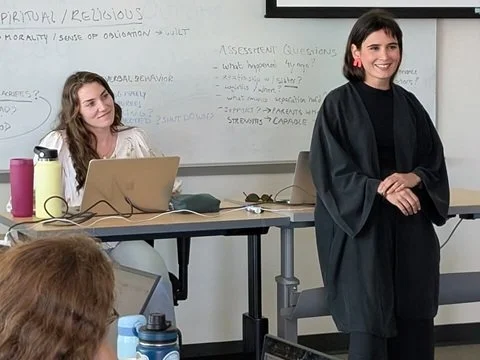
Sentio's program is described as "the first graduate psychotherapy program to thoroughly integrate deliberate practice with roughly half of nearly every class session dedicated to active skills training rather than lecture" (Rousmaniere & Vaz, 2025, p. 2). That structure means that the online instructional format is not used primarily for passive content delivery. Instead, the platform is used to support repeated behavioral rehearsal of clinical skills, with real client material from the Sentio Counseling Center practicum informing classroom exercises. As Rousmaniere and Vaz have described the goal: "the classroom becomes an active training ground rather than a passive learning space" (Rousmaniere & Vaz, 2025, p. 3).
Sentio's supervision model adds a specific technological layer: all therapy sessions are videotaped, all counselors use routine outcome monitoring every session with every client, all supervision sessions are videotaped, and supervisors are trained through a video-based supervision training program (Rousmaniere & Vaz, 2025, pp. 1-2) that now runs in six- and twelve-month tracks. This design means that the program's hybrid format was built from the ground up around video review and technology-integrated supervision, rather than adapted from an existing in-person model.
The evidence base for this kind of structure includes the Sentio Supervision Model (SSM) case study published in the Journal of Clinical Psychology (Brand et al., 2025), which documented measurable clinical improvement in both trainee and client outcomes through the SSM's 7-step, video-integrated, outcome-monitored approach. The supervision model is designed to fit within a 50-minute supervision meeting (Brand et al., 2025, p. 2), meaning that technology integration serves to increase efficiency and accountability rather than lengthen sessions.
Like any program, Sentio has limitations worth understanding. Because it is a newer institution, it has a smaller alumni network than established programs, which may matter for professional networking depending on your career goals. Its focus on deliberate practice methodology is distinctive but also means that the program's identity is closely tied to a specific training philosophy; students who prefer a more traditional or eclectic instructional approach may find the emphasis on behavioral rehearsal to be more prescriptive than they prefer. Prospective students should read the published descriptions of the program's methodology carefully before applying to any program. You can find more information about Sentio's approach in the Sentio FAQ.
For those interested in how AI is integrated into clinical training at the graduate level, Sentio has also published work in this area. You can review Sentio's AI-related research and resources on the free AI course for therapists page.
Making Your Decision
The decision between a hybrid and an in-person MFT program is ultimately less important than the decision about which specific program uses its format to genuinely develop your clinical skills. Every program, in every format, should be evaluated on the quality of its supervision, the structure of its skills training, its transparency about student outcomes, and its track record of supporting graduates to licensure.
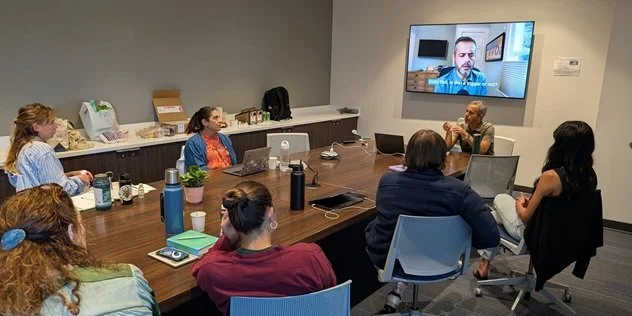
One recommendation that applies universally: ask each program you are seriously considering whether you can observe a live class session, whether in person or via video. Marketing materials and admissions conversations are designed to present a program in its best light, and there is no substitute for seeing how an actual class session is structured, how faculty interact with students, and whether the tone of the learning environment matches what you need. Every program worth attending should welcome this request, and many will actively encourage it. Programs that are reluctant to allow prospective students to observe a class are programs whose marketing materials may not accurately represent the day-to-day experience of students.
Cut through the marketing hype by seeing it yourself. Ask each program on your list: can I attend a class? To learn more about what the Sentio MFT program looks like in practice, including the option to observe a class, visit the program overview page.
Keep reading
In-person residencies in hybrid MFT programs, what the intensive weeks actually involve
Can you complete your practicum and supervised hours online?, the rules for remote hours in California
Remote and telehealth supervision for LMFT hours, what SB 775 means for you
MFT licensing in San Diego, programs and career outlook in the region
Frequently Asked Questions
Are hybrid MFT programs accepted by the California BBS for licensure?
Yes, with qualifications. The California BBS approves MFT programs based on accreditation status and adherence to its curricular and supervisory requirements, not on delivery format per se. The BBS has developed specific guidelines permitting supervision via HIPAA-compliant videoconferencing, and its Telehealth Committee has been actively working on the framework governing distance supervision. However, not every component of every hybrid program is automatically accepted, and limits have historically existed on the percentage of supervised hours that can be accrued via distance supervision depending on the state licensing board involved. Prospective students should confirm directly with any program they are considering that its hybrid structure has been reviewed and approved for BBS licensure purposes, and should also review the current BBS regulations at bbs.ca.gov.
Can I complete my MFT practicum hours through a hybrid program?
The practicum itself, meaning the direct client contact hours, must still occur with real clients in real clinical settings. A hybrid program does not change the 3,000-hour supervised experience requirement, including the minimum 1,750 hours of direct client contact. What a hybrid format can change is where and how supervision of those hours is conducted, and how clinical skill training is integrated into your coursework. Ask each program you are considering how it coordinates practicum placements and whether it has established training site partnerships in your geographic area of California. For a full breakdown of post-graduation requirements, see our guide to how long it takes to become an LMFT in California.
How do hybrid MFT programs handle skills training and role-plays?
This varies significantly by program. Some hybrid programs conduct behavioral rehearsal exercises in synchronous online class sessions using videoconferencing platforms, with students practicing clinical responses on each other or on simulated cases. Others incorporate in-person intensive periods for skills practice. Research suggests that the key variables are not whether role-plays happen in person or via video, but whether they involve structured learning goals, repeated rehearsal of specific skills, and immediate corrective feedback from a trained supervisor. Passive skills training, whether in person or online, is unlikely to produce durable skill acquisition. When evaluating any program, ask specifically what the structure of its skills training looks like and whether faculty can describe the research basis for their approach.
Is a hybrid MFT program easier or harder than a fully in-person program?
Neither, as a general rule. Hybrid programs that are rigorous require the same volume of reading, supervised hours, and clinical competency as in-person programs. What changes is the logistical structure. Some students find the flexibility of hybrid scheduling reduces stress and allows for better integration with work and family responsibilities. Others find that the self-direction required in an online format is more demanding than they anticipated, particularly in the first year. A good indicator of a program's rigor is whether it uses routine outcome monitoring for student clinical work, whether supervisors have formal training in supervision methodology, and whether the program can point to published evidence for its training model.
What technology do I need for a hybrid MFT program?
At minimum, a reliable computer with a webcam, a stable high-speed Internet connection, and a private space for conducting supervision and role-play exercises. Most programs using videoconference platforms require a broadband connection sufficient for clear video; the average global Internet speed crossed that threshold more than a decade ago (Rousmaniere, 2014, p. 218). If your program conducts video-recorded supervision of client sessions, you will also need to understand and follow HIPAA-compliant protocols for video storage and transmission, which your practicum site and program should provide guidance on. Some programs have specific platform requirements; ask in advance what software you will be expected to use and whether any technical orientation or support is provided.
Can students in the Inland Empire or Long Beach access quality hybrid MFT programs?
Yes. Statewide online hybrid programs are accessible from anywhere in California with adequate Internet access, which describes the vast majority of the Inland Empire and Long Beach. The more important question for students in these regions is whether a given hybrid program has practicum partnerships with training sites in their geographic area, so that the supervised clinical hours component of the degree does not require extensive travel. Students in these regions should also be aware that California's behavioral health workforce data indicates significant unmet need for licensed therapists in inland and suburban communities, which means that completing an MFT program and seeking licensure in these areas can be both professionally viable and socially meaningful. You can learn more about how becoming an MFT in California works at every stage from enrollment through licensure.
References
Board of Behavioral Sciences. (2024). Licensing population report September 2024. https://www.bbs.ca.gov/pdf/board_minutes/2024/20241114-15_item9.pdf
Board of Behavioral Sciences. (2025). Executive officer report August 2025. https://bbs.ca.gov/pdf/agen_notice/2025/20250821_22_item_15.pdf
Board of Behavioral Sciences. (2025). Telehealth and supervision via videoconferencing. https://www.bbs.ca.gov/pdf/board_minutes/2024/20241114-15_item17.pdf
Brand, J., Miller-Bottome, M., Vaz, A., & Rousmaniere, T. (2025). Deliberate practice supervision in action: The Sentio supervision model. Journal of Clinical Psychology, 1–11. https://doi.org/10.1002/jclp.23790
Bureau of Labor Statistics. (2024). Occupational employment and wage statistics: Marriage and family therapists. https://www.bls.gov/oes/2023/may/oes211013.htm
Levenson, H. (2024). What deliberate practice supervision has to offer traditional supervision: Nine take-home messages. Psychotherapy Bulletin, 59(3), 55–59. https://societyforpsychotherapy.org/what-deliberate-practice-supervision-has-to-offer-traditional-supervision-nine-take-home-messages/
Rousmaniere, T. (2014). Using technology to enhance clinical supervision and training. In C. E. Watkins, Jr. & D. L. Milne (Eds.), The Wiley international handbook of clinical supervision (pp. 204–237). John Wiley & Sons. ISBN: 978-1-118-84636-0. https://doi.org/10.1002/9781118846360.ch9
Rousmaniere, T., & Vaz, A. (2025). Sentio's clinic-to-classroom method: Bridging deliberate practice and clinical training. Psychotherapy Bulletin, 60(2), 79–84. https://societyforpsychotherapy.org/sentios-clinic-to-classroom-methodbridging-deliberate-practice-and-clinical-training/
Government resources:
California Board of Behavioral Sciences: https://www.bbs.ca.gov
California Department of Health Care Access and Information (HCAI): https://hcai.ca.gov
U.S. Bureau of Labor Statistics, Marriage and Family Therapists: https://www.bls.gov/ooh/community-and-social-service/marriage-and-family-therapists.htm
About the Authors
Tony Rousmaniere, PsyD is the President of Sentio University and Executive Director of the Sentio Counseling Center. He is Past-President of the psychotherapy division of the American Psychological Association and the author of over 20 books on deliberate practice and psychotherapy training, including The Essentials of Deliberate Practice book series (APA Books). He is a licensed psychologist in California and Washington. Learn more
Alexandre Vaz, PhD is the Chief Academic Officer of Sentio University and cofounder of the Deliberate Practice Institute. He is co-editor of The Essentials of Deliberate Practice book series (APA Books) and the author of over a dozen books on deliberate practice and psychotherapy training. Dr. Vaz is the founder and host of Psychotherapy Expert Talks. He is a licensed clinical psychologist in Portugal. Learn more