
How to Evaluate MFT Supervision Quality When Choosing a Program
How to Evaluate MFT Supervision Quality When Choosing a Program
Supervision is the clinical heart of any Marriage and Family Therapy training program, yet it is rarely the first question prospective students ask. Most program comparisons focus on tuition, scheduling, theoretical orientation, and licensure pass rates. Those factors matter, but they often leave out the one variable that will most directly determine whether you graduate as a clinician who can actually help people: the quality and structure of the supervision you receive.
Research published over the past decade has produced findings about supervision that are, at minimum, sobering. Studies suggest that most supervisors receive little formal training for the role, that a substantial majority of supervisees withhold important clinical information from their supervisors, and that supervision as it is commonly practiced has not been shown to reliably improve client outcomes. At the same time, a growing body of evidence points to what effective, evidence-based supervision can look like when programs invest seriously in it.
This post is designed to help prospective MFT students in California ask sharper questions about supervision before committing to a program. It draws on peer-reviewed research from psychotherapy training scholars, with Sentio University cited as one concrete example of a program that has published its supervision approach in academic literature. Every student's needs are different, and the goal here is informed decision-making, not advocacy for any single program.
Last updated: September 2026
Why Is Supervision Quality the Most Underrated Factor in Choosing an MFT Program?
When evaluating MFT programs, prospective students understandably focus on factors that are easy to compare: cost per unit, LMFT Clinical Examination pass rates, faculty credentials listed on a website, and clinical hour requirements. Supervision is harder to evaluate from the outside, and programs rarely advertise the specific structure of their supervision model in detail. This information gap tends to push supervision quality toward the bottom of the decision checklist, even though it may matter most for your clinical development. Students beginning their research into how to become an MFT in California will benefit from understanding this early.
Consider what clinical supervision actually is. It is the primary mechanism through which you are supposed to translate coursework into skill. It is where you bring recordings or descriptions of your real sessions with real clients, receive feedback from an experienced clinician, and practice doing something differently. If that feedback loop is weak, vague, or primarily conceptual rather than behavioral, the gap between knowing about therapy and actually doing it well tends to persist through graduation and into licensure.
As Tony Rousmaniere, PsyD, and colleagues noted in The Cycle of Excellence (Rousmaniere, Goodyear, Miller, & Wampold, 2017), "Since the days of Freud, it has been assumed that experience as a clinician is sufficient to make one an effective supervisor. This assumption stands in contrast to many other fields, which define the role of a coach as clearly distinct from that of a performer and do not assume that great performers are automatically effective coaches." (p. 271). That assumption, still largely unchallenged in many training programs, has significant consequences for students who do not know to question it.
For students in California, the stakes are also practical. The state requires 3,000 hours of supervised experience before licensure, most of it after graduation, and the quality of that post-graduate supervision matters as much as what you received in training. Programs that take supervision seriously enough to train their supervisors, record their sessions, and measure client outcomes are modeling a professional standard that prepares graduates to seek out and evaluate quality supervision throughout their careers.
What Does the Research Say About Supervision Effectiveness in Therapy Training?
Supervision as currently practiced across most training programs has a weak evidence base. This is not a fringe finding. It has been documented by some of the most respected researchers in the field, many of them supervisors and trainers themselves.
In Deliberate Practice for Psychotherapists (Rousmaniere, 2017), Tony Rousmaniere, PsyD, summarized a study of 6,521 clients, 175 therapists, and 23 supervisors: "supervisors accounted for less than .01% of the variance in psychotherapy outcome, a finding that a colleague called 'horrifying.'" (pp. 11-12). That same book documents that 84% of trainees reported withholding information from their supervisors, with negative perceptions of the supervision relationship being the most common topic withheld (p. 10).
The structural problems run deeper than individual supervisory relationships. According to Rousmaniere, Goodyear, Miller, and Wampold (2017), "Becoming a supervisor commonly requires little formal training or role induction beyond attending 5 to 10 hours of lecture-style learning." (p. 271). This means the person most responsible for your clinical development during training may have received less formal preparation for that role than a barista receives before their first shift.
The consequences show up in trainee surveys. Rousmaniere (2017) cited findings indicating that 93% of supervisees are in "inadequate supervision" and over half have received harmful clinical supervision (p. 35), and that fewer than 5% of supervisees reported that their supervisors were regularly engaging in explicit collaborative supervision (p. 34). These numbers are not from a study of notoriously bad programs. They reflect the field's baseline.
Rodney K. Goodyear, PhD, and Tony Rousmaniere, PsyD, writing in the same volume, concluded directly: "by the measure of improved client outcomes, the success of supervision is yet to be convincingly established." (Goodyear & Rousmaniere, 2017, p. 68). And Rousmaniere et al. (2017) stated the problem even more plainly, noting that the data suggest "supervision as currently practiced does not have a reliable impact on client outcome." (p. 271). For a deeper look at the training methodology designed to address these findings, see our overview of deliberate practice in psychotherapy.
None of this is cause for despair. Research also shows that when supervision is deliberately structured around behavioral rehearsal, video review, outcome monitoring, and ongoing feedback, outcomes for both trainees and their clients can improve. The question for prospective students is how to tell the difference between a program that has thought carefully about this and one that has not.
What Should You Look for in an MFT Program's Supervision Model in 2026?
The research literature on supervision effectiveness points toward several concrete features that distinguish evidence-informed supervision from the traditional model. When evaluating programs, you can ask directly about each of these. Using a structured program evaluation framework can help you track how different programs measure up across these criteria.
Supervisor training. How are supervisors prepared to supervise? Are they trained specifically in supervision methodology, or does the program assume that clinical experience is sufficient? Programs that train supervisors in a structured, evidence-based supervision model are making a meaningful investment in the quality of your training experience.
Outcome monitoring. Does the program use routine outcome measurement with every client, every session? Outcome data makes supervision concrete: instead of discussing how a session felt, supervisor and trainee can examine whether the client is actually improving. Without this data, supervision easily drifts toward conceptual discussion rather than behavioral change. Programs aligned with evidence-based training principles typically require trainees to administer validated outcome measures such as the OQ-45 routinely and bring that data to supervision.
Video recording of sessions. Whether therapy sessions are recorded and reviewed in supervision is a meaningful structural indicator. Reviewing recorded sessions allows supervisors to observe what actually happened rather than relying on the trainee's memory and self-report. Research has documented that therapists tend to be poor judges of their own performance, making independent observation a critical safeguard (Rousmaniere, 2017).
Behavioral rehearsal in supervision. Does supervision include actual practice within the session itself? Goodyear and Rousmaniere (2017) described the goal of the Expertise-Development Model this way: "Supervisors and consultants who use the Expertise-Development Model focus on isolating and practicing specific behavioral component skills within those goals." (p. 82). This is distinct from the more common approach of discussing what the trainee should have done differently. Practice in supervision is the behavioral analog to the work musicians and athletes do: not just analyzing performance, but rehearsing it.
Supervision of supervision. The most rigorous programs also ensure that the supervisors themselves receive ongoing consultation on their supervision. This is sometimes called supervision-of-supervision or consultation-of-supervision, and it introduces the same accountability loop into the supervisory layer that evidence-based supervision introduces into therapy.
You are unlikely to find all of these features in every program, and their presence or absence does not automatically make a program right or wrong for your particular goals. But asking about them directly will tell you a great deal about how seriously a program has engaged with the evidence on what effective supervision requires.
How Important Is Video Review in MFT Supervision?
Video review is one of the most consistent markers separating evidence-based supervision from traditional approaches. Its importance is not simply technological; it is epistemological. Without video, supervision is based almost entirely on the trainee's account of what happened in session. That account is filtered through memory, self-perception, and the natural tendency to present oneself favorably to an evaluator.
Hanna Levenson, PsyD, a psychotherapy training expert who spent over 40 years teaching more than two thousand graduate students, observed Sentio University's supervision structure over a year and a half and offered an independent perspective on video use in clinical supervision. She wrote: "In the past, I have written about how supervision has been the most closeted component of psychotherapy training -- no one records or shows their supervision sessions. In these Sup-of-Sup meetings, however, the door is thrown wide open!" (Levenson, 2024, p. 2).
Levenson's observation captures a broader dynamic in the field. Therapy sessions are rarely recorded in traditional training programs, and supervision sessions almost never are. The default is privacy, which protects comfort but limits accountability. Programs that record both therapy sessions and supervision sessions create conditions in which actual clinical behavior, rather than reported clinical behavior, can be examined and improved.
For students, the practical question is whether video recording is built into the program's structure or left to individual supervisors' preferences. Programs where video review is systematic and expected will produce a different training experience than those where it is optional or rare. When speaking with admissions staff, ask not just whether video is permitted but whether it is routine.
California's Board of Behavioral Sciences has acknowledged the legitimacy of videoconference-based supervision for triadic and group supervision, reflecting the field's increasing recognition that technology can expand the quality and reach of supervision (BBS, 2024). Programs already using video review of therapy sessions are often better positioned to integrate these regulatory developments into their supervision model.
What Questions Should Santa Barbara and Coastal California Students Ask About Supervision?
Students in Santa Barbara and along the Central Coast of California face a specific challenge: the region has relatively few MFT training programs compared to Los Angeles or the Bay Area, and the programs available span a wide range of formats and funding models. Many students in this region ultimately pursue hybrid or online programs that allow them to complete coursework remotely while maintaining practicum placements locally. Understanding the full California MFT licensure requirements can help clarify what to prioritize.
For these students, supervision quality is especially important to evaluate carefully because the physical distance from the institution makes the supervision relationship one of the primary points of actual contact with the program. Below are concrete questions worth asking any program you are considering, regardless of location.
Who specifically will supervise me, and what training have they received for that role? This is not a question about credentials (LMFT vs. LPCC, for example) but about how the program prepares its supervisors to supervise. Can the program describe a specific training process? Students weighing the differences between MFT and LCSW pathways should note that supervision structure varies across both license types.
How many clients will I carry in practicum, and how many supervision hours will I receive? California's BBS requires a minimum of one hour of individual or triadic supervision, or two hours of group supervision, per week during the supervised experience period following graduation, but training programs vary significantly in what they offer during the degree itself.
Will my therapy sessions be recorded? Who reviews those recordings, and how? If the answer is vague or optional, that tells you something about how the program structures the feedback loop between what happens in session and what gets addressed in supervision.
Does the program use routine outcome monitoring with all clients? Systematic tracking of client progress using validated instruments is an evidence-supported practice that also happens to develop a habit you will want as a licensed clinician.
How are poor clinical outcomes handled in supervision? This question often reveals a great deal about a program's supervision culture. Programs that have a structured process for identifying and addressing treatment non-response are demonstrating a different level of clinical seriousness than those where the topic is rarely discussed.
You can also ask programs whether you may attend a live supervision session or observe a class before you apply. Every reputable program should welcome this request. The experience of watching actual supervision in a program is irreplaceable as an evaluation tool and is discussed further in the closing section of this post.

How Does the Sentio MFT Program Approach Supervision?
This section provides a factual description of Sentio University's supervision model as one concrete example of how an evidence-based approach to supervision can be structured. It is not a comprehensive review of all programs with strong supervision, and it is not intended as an endorsement of Sentio for any particular student. For information about Sentio's program requirements and format, visit the Sentio FAQ.
Sentio University, a nonprofit graduate school in California, has published several peer-reviewed articles describing its supervision model in detail. Because the model has been described in academic literature by both internal faculty and external reviewers, it offers a relatively transparent example of what evidence-based supervision can look like in practice. Students exploring how to choose an MFT program in California may find it useful as a reference point.
The centerpiece of Sentio's approach is the Sentio Supervision Model (SSM), a seven-step framework that structures each 50-minute supervision session around four integrated components: review of routine outcome monitoring data from the previous session, viewing of a video recording of the therapy session, identification of a specific clinical skill to target, and behavioral rehearsal of that skill within the supervision hour itself (Brand, Miller-Bottome, Vaz, & Rousmaniere, 2025). The model was developed to address what the authors describe as a common failure of traditional supervision: training therapists to talk well about therapy rather than practice performing it.
Jason Brand, MSW, a Sentio supervisor and first author of the 2025 SSM case study, described the experience from the supervisor's side: "What I have come to learn is that supervisees actually really appreciate direct corrective feedback when contained within the SSM. The more comfortable I have become with my corrective feedback, the more my supervisees are reporting that they can see and feel themselves becoming better therapists in each supervision hour." (Brand et al., 2025, p. 7).
Several features of the Sentio model are worth noting for students evaluating how supervision is structured in programs they are considering.
All therapy sessions are videotaped. Every client session at the Sentio Counseling Center is recorded, and those recordings are reviewed in supervision. This is described in the published program description as a baseline expectation, not an option (Rousmaniere & Vaz, 2025).
All clients are tracked via routine outcome monitoring every session. Outcome data is used actively in supervision to identify cases where treatment is not progressing and to focus the supervisor's attention on clinical skill gaps rather than general impressions.
Supervisors complete a structured training program while supervising trainees. Sentio supervisors are trained through a rigorous video-based supervision training program (Rousmaniere & Vaz, 2025, p. 2) that now runs in six- and twelve-month tracks, and they train while supervising, reviewing video of their own supervision sessions with senior trainers each week. This stands in contrast to the field-wide norm documented by Rousmaniere et al. (2017), in which supervisor preparation typically consists of five to ten hours of lecture.
Supervision itself is supervised. Sentio runs what it calls supervision-of-supervision (Sup-of-Sup) meetings, in which Alexandre Vaz, PhD, Chief Academic Officer, reviews recordings of supervisor sessions with trainees and provides consultation directly on the supervision. Hanna Levenson, PsyD, who observed these meetings as an external reviewer, described the format: "In the 60-minute meeting, Alex usually consults with three supervisors on one of their supervision sessions for that week" (Levenson, 2024, p. 1). This layer of accountability does not exist in most training programs.
The supervision model is integrated with the program's broader deliberate practice approach. Sentio's published curriculum describes the program as the first MFT graduate program to dedicate approximately half of nearly every class session to active skills training rather than lecture (Rousmaniere & Vaz, 2025). Supervision in this context is one component of a larger training structure, not a standalone requirement.
Sentio has also developed an AI-integrated training component. Students interested in how programs are incorporating artificial intelligence into clinical training can review Sentio's publicly available materials in Sentio's free AI course for therapists and read more about the intersection of AI and mental health training.
As with any program, Sentio's model has trade-offs. It is a smaller program with a specific philosophical orientation rooted in deliberate practice. Students who prefer a more eclectic theoretical environment, a larger cohort, or a program with a longer institutional history may find that other programs are a better fit for their goals. The point of describing Sentio's model here is not to suggest it is the only rigorous approach but to give prospective students a concrete example of what a published, peer-reviewed supervision framework looks like, so they have a reference point for asking similar questions of any program they consider.
Keep reading
How to evaluate a therapy graduate program in California, the full evaluation framework this post is one piece of.
How therapist licensure works in California, the full sequence from degree to license.
MFT programs in California, every BBS-approved program in the state.
Remote and telehealth supervision for LMFT hours, what SB 775 means for your supervision.
Frequently Asked Questions About MFT Supervision Quality
How can I tell if an MFT program's supervision will actually improve my clinical skills?
The most reliable indicators are structural, not promotional. Ask whether supervision sessions include behavioral rehearsal within the session itself, whether client sessions are recorded and reviewed, whether the program uses validated outcome measures with every client, and how supervisors are trained for their role. Programs that can answer those questions specifically and in writing are demonstrating a level of intentionality about supervision that programs relying on marketing language usually cannot match. You can also ask to observe a live supervision session before you enroll. Any program confident in its supervision model should welcome that request.
What is the Sentio Supervision Model?
The Sentio Supervision Model (SSM) is a seven-step, 50-minute supervision framework published in the Journal of Clinical Psychology (Brand, Miller-Bottome, Vaz, & Rousmaniere, 2025). It integrates review of client outcome monitoring data, video review of recorded therapy sessions, identification of a specific behavioral skill target, and in-session rehearsal of that skill within each supervision meeting. The model is built on deliberate practice principles drawn from expertise science and is used at Sentio University as part of a broader training system. Sentio is not the only program using structured supervision approaches, but it is one of the few programs whose supervision model has been described and examined in peer-reviewed literature.
Should I look for MFT programs that video-record supervision sessions?
Video recording of therapy sessions is the more immediate priority, because it allows supervisors to observe what actually happened in session rather than relying on the trainee's self-report. Research has consistently found that therapists are poor judges of their own performance, which makes independent video review a meaningful quality safeguard. Video recording of supervision sessions themselves is a higher bar that very few programs currently meet, but it represents the next logical step for programs serious about supervision accountability. When evaluating programs, asking whether therapy sessions are routinely recorded and reviewed is a reasonable starting point.
What is supervision-of-supervision and why does it matter?
Supervision-of-supervision, sometimes called consultation-of-supervision or Sup-of-Sup, is a practice in which supervisors receive ongoing consultation on their own supervision work, often through review of recorded supervision sessions. It mirrors the same accountability principle that applies to therapists: just as trainees benefit from having their sessions observed and discussed, supervisors benefit from having their supervisory work examined by a more experienced consultant. Its relevance to prospective students is practical. Programs that invest in supervision-of-supervision are signaling that they hold the quality of supervision to a standard, rather than assuming that supervisor credentials alone are sufficient.
How much supervision will I get in a typical MFT program?
California's Board of Behavioral Sciences requires a minimum of one hour of individual supervision per week (or two hours of group supervision) during the post-graduation supervised experience period, and caps group supervision at eight supervisees to one supervisor. Within degree programs, the amount and format of supervision varies considerably. Some programs provide individual supervision, others rely primarily on group or triadic formats, and the total hours required differ. Before enrolling, ask specifically how many hours of individual supervision are provided each term, whether group supervision counts toward those hours, and what the supervisor-to-student ratio is in practicum placements. You can also review the BBS Handbook for Future LMFTs at bbs.ca.gov for the regulatory minimums.
What is the difference between individual and group supervision in MFT training?
Individual supervision involves one-on-one work between a supervisor and a single trainee, allowing detailed focus on that trainee's specific clinical situations and skill development needs. Group supervision involves a supervisor working with multiple trainees at once, which can provide exposure to a broader range of clinical material and peer learning opportunities but typically reduces the per-trainee time spent on any individual case. Both formats have value, and most programs use a combination. What matters for your development is not simply which format is offered but whether the format is used in a structured, outcome-focused way. A group supervision session built around video review and behavioral rehearsal may provide more skill development than an individual session conducted primarily as a case discussion.
The Decision Is Yours
Supervision quality is one of the most consequential factors in your development as a therapist, and it is also one of the hardest to evaluate from the outside. Program websites are designed to present programs favorably. Admissions staff are, by definition, advocates for their institution. Published statistics about graduation rates and licensure pass rates tell you something about student persistence, but they do not tell you much about the clinical training environment that produced those numbers.
The most direct way to cut through the marketing and understand what a program is actually like is to ask to attend a live class or observe a supervision session before you enroll. This is not an unusual or presumptuous request. Every program that is confident in the quality of its training environment should not only permit it but actively encourage it. If a program hesitates or declines, that response itself is useful information. If a program welcomes the visit and the session you observe feels substantive, behaviorally focused, and honest about what it looks like to develop clinical skill, that is evidence of a program taking its training mission seriously.
Ask each program you are considering: can I attend a class or observe a supervision session? Ask it of every program on your list, not just one. The answers will vary, and those differences will tell you more about supervision culture than any brochure can. For a detailed look at what Sentio University's MFT program offers, including the opportunity to observe a class, visit the program overview page.
For additional information about California MFT licensure requirements and supervision regulations, visit the California Board of Behavioral Sciences directly.
References
Board of Behavioral Sciences. (2024). Telehealth and supervision via videoconferencing. Item 17, November 2024 Board Meeting. https://www.bbs.ca.gov/pdf/board_minutes/2024/20241114-15_item17.pdf
Board of Behavioral Sciences. (2024). Handbook for future LMFTs. https://www.bbs.ca.gov/pdf/publications/lmft_handbook.pdf
Brand, J., Miller-Bottome, M., Vaz, A., & Rousmaniere, T. (2025). Deliberate practice supervision in action: The Sentio Supervision Model. Journal of Clinical Psychology, 1-11. https://doi.org/10.1002/jclp.23790
Goodyear, R. K., & Rousmaniere, T. (2017). Helping therapists to each day become a little better than they were the day before: The Expertise-Development Model of supervision and consultation. In T. Rousmaniere, R. K. Goodyear, S. D. Miller, & B. E. Wampold (Eds.), The cycle of excellence: Using deliberate practice to improve supervision and training (pp. 67-96). John Wiley & Sons. ISBN: 978-1-119-16556-9. https://doi.org/10.1002/9781119165590.ch4
Levenson, H. (2024). What deliberate practice supervision has to offer traditional supervision: Nine take-home messages. Psychotherapy Bulletin, 59(3), 55-59. https://societyforpsychotherapy.org/what-deliberate-practice-supervision-has-to-offer-traditional-supervision-nine-take-home-messages/
Rousmaniere, T. (2017). Deliberate practice for psychotherapists. Routledge. ISBN: 978-1-138-20320-4. https://doi.org/10.4324/9781315472256
Rousmaniere, T., Goodyear, R. K., Miller, S. D., & Wampold, B. E. (2017). Improving psychotherapy outcomes: Guidelines for making psychotherapist expertise development routine and expected. In T. Rousmaniere, R. K. Goodyear, S. D. Miller, & B. E. Wampold (Eds.), The cycle of excellence: Using deliberate practice to improve supervision and training (pp. 267-275). John Wiley & Sons. ISBN: 978-1-119-16556-9. https://doi.org/10.1002/9781119165590.ch13
Rousmaniere, T., & Vaz, A. (2025). Sentio's clinic-to-classroom method: Bridging deliberate practice and clinical training. Psychotherapy Bulletin, 60(2), 79-84. https://societyforpsychotherapy.org/sentios-clinic-to-classroom-methodbridging-deliberate-practice-and-clinical-training/
APA Essentials of Deliberate Practice series: https://www.apa.org/pubs/books/browse
California Board of Behavioral Sciences: https://www.bbs.ca.gov
California Department of Health Care Access and Information (HCAI) Behavioral Health Workforce Programs: https://hcai.ca.gov/workforce/financial-assistance/grants/bhp/
About the Authors
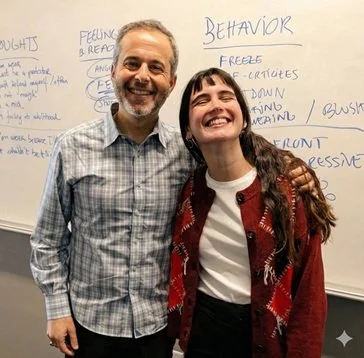
Tony Rousmaniere, PsyD is the President of Sentio University and Executive Director of the Sentio Counseling Center. He is Past-President of the psychotherapy division of the American Psychological Association and the author of over 20 books on deliberate practice and psychotherapy training, including The Essentials of Deliberate Practice book series (APA Books). He is a licensed psychologist in California and Washington. Learn more
Alexandre Vaz, PhD is the Chief Academic Officer of Sentio University and cofounder of the Deliberate Practice Institute. He is co-editor of The Essentials of Deliberate Practice book series (APA Books) and the author of over a dozen books on deliberate practice and psychotherapy training. Dr. Vaz is the founder and host of Psychotherapy Expert Talks. He is a licensed clinical psychologist in Portugal. Learn more