
MFT Job Growth and Demand in California: What the Data Tells Prospective Students
MFT Job Growth and Demand in California: What the Data Tells Prospective Students
Employment Projections, Workforce Shortage Data, and the Future of the MFT Profession in California
If you are considering a career as a Marriage and Family Therapist in California, the structural conditions of the job market matter as much as your passion for the work. In 2026, those conditions are unusually favorable. The Bureau of Labor Statistics projects 8% employment growth for counselors, social workers, and related specialists from 2025 to 2035, adding approximately 230,900 new jobs nationally (BLS, 2026). Within California, a combination of regulatory investment, state scholarship programs, and a permanent telehealth expansion is accelerating that growth. At the same time, the field is changing rapidly: AI tools are reshaping how mental health support is delivered, telehealth has permanently altered service geography, and training methodology is emerging as a differentiator among new graduates competing for jobs. This post draws on government data, peer-reviewed research, and regulatory reports to give prospective MFT students a clear-eyed view of what the job market actually looks like, what skills employers will value, and what questions to ask any program before enrolling. For a broader look at compensation across settings and regions, see our California MFT salary guide.
Last updated: September 2026
How Fast Is the MFT Job Market Growing in California?
The national employment outlook for marriage and family therapists and closely related roles is measured by the Bureau of Labor Statistics Occupational Outlook Handbook. The BLS projects 8% job growth from 2025 to 2035 for the broader counselors, social workers, and community and social service specialists category, representing approximately 230,900 new positions nationally (BLS, 2026). California consistently absorbs a disproportionate share of that growth due to the state's size, population density, and the scope of its public behavioral health system.
In terms of wages, California already pays well above the national median. The BLS recorded a mean annual wage of $69,780 for Marriage and Family Therapists in California as of May 2023, compared to a national median of $63,780 in 2024 (BLS, 2024). That statewide average conceals significant regional variation. The San Francisco-Oakland-Hayward metro area reports a mean annual MFT wage of $92,370, while Vallejo-Fairfield reaches $109,130 and the Sacramento region sits at $81,080 (BLS, 2024). The highest wages tend to appear in smaller, higher-need regions where therapist supply is thin relative to population demand, a pattern that has meaningful implications for career planning and specialization.
Industry setting matters as well. Nationally, school-based MFT positions carry a mean annual wage of approximately $89,000, while state government roles average $84,770. Outpatient care centers and individual and family services organizations average closer to $67,000 to $68,000 (BLS, 2024). For prospective students, the decision about which populations and settings to prioritize in training has downstream consequences for both compensation and job availability.
How Severe Is the Mental Health Workforce Shortage in California?
The demand side of the MFT job market is shaped by an acute and geographically uneven shortage of mental health providers. According to the Department of Health Care Access and Information, 40 out of 58 California counties, nearly 70 percent, may need additional behavioral health providers in hospital inpatient and emergency department settings (HCAI, 2024). In the most underserved counties, the situation is extreme: 10 California counties currently have a ratio of 1,000 or more patient encounters with a behavioral health diagnosis per licensed provider, against a statewide average of 145 patient encounters per provider (HCAI, 2024).
The shortage is not unique to California. According to research published in Practice Innovations, more than half the U.S. population, approximately 169 million people, lives in federally designated Mental Health Professional Shortage Areas (Rousmaniere, Zhang, Li, & Shah, 2025, p. 4). That same study found that 48.7% of survey participants with mental health conditions had used large language models for psychological support in the past year, a finding that reflects both the scale of unmet need and the ways people are attempting to bridge gaps in access (Rousmaniere et al., 2025).
For new graduates entering the workforce, this shortage translates directly into employment opportunity. Regions that appear saturated on paper, such as Los Angeles, still absorb large numbers of new therapists annually because demand so substantially outpaces supply. For graduates willing to work in underserved rural or low-income settings, the state has created specific financial incentives to support that choice, described in more detail below.
How Many MFTs Are Currently Practicing and In Training in California?
The Board of Behavioral Sciences is the regulatory authority for MFTs in California. Its most recent administrative data gives a detailed picture of the current workforce. As of September 2024, there were 48,679 active Licensed Marriage and Family Therapists in California, along with 15,812 active Associate Marriage and Family Therapists working toward licensure (BBS, 2024). The total BBS licensee and registrant population across all license categories reached approximately 151,854 as of mid-2025, up from 130,343 in FY 2021-2022, a sustained growth trend (BBS, 2025).
The ratio of AMFTs to LMFTs is worth examining. The 15,812 active associates represent a substantial pipeline of professionals mid-way through the licensure process, each completing the 3,000 supervised clinical hours required for full licensure. The BBS requires a minimum of 104 weeks to accumulate those hours, with at least 1,750 hours in direct clinical counseling and at least one hour of direct supervisor contact in every week that counts, in each setting where the associate works, plus a second hour in any setting with more than ten hours of direct counseling that week (Business and Professions Code section 4980.43.2). This pipeline has been accelerating: AMFT registration processing times dropped from an average of 52 days to 27 days in FY 2024/2025, with fourth-quarter processing times recorded as low as 12 days, a 48% reduction that meaningfully shortens the gap between graduation and paid clinical work (BBS, 2025). For a full walkthrough of each phase from graduation through licensure, see our post on the MFT career trajectory from associate to licensed therapist.
Exam volume is also rising. In the fourth quarter of FY 2024/2025, a total of 6,367 exams were administered by the BBS, a 6.65% increase over the previous quarter, reflecting the growing pipeline of candidates reaching the licensure threshold (BBS, 2025). First-time pass rates for the LMFT Law and Ethics Examination run approximately 85 to 86%, while first-time pass rates for the LMFT Clinical Examination run approximately 79 to 83%, underscoring the value of programs that emphasize clinical reasoning and ethical decision-making throughout training rather than only in exam preparation (BBS, 2023). For a complete breakdown of the steps and requirements, see our guide to California MFT licensure requirements.

What Role Does Telehealth Play in Expanding MFT Job Opportunities?
The pandemic-era expansion of telehealth has become permanent. According to the Department of Health Care Services, telehealth accounted for less than 10% of specialty mental health sessions before 2020, peaked near 50% during the height of the pandemic, and leveled off at just above 30% as of 2022, representing a 300% increase over the 2019 baseline (DHCS, 2024). That 30% baseline is now the new floor, not an anomaly.
The clinical validity of telehealth is well established. Research reviewed by the California Legislative Analyst's Office found that behavioral health services delivered through live video are generally as clinically effective as those provided in person, and that telehealth specifically reduces appointment cancellation rates and helps clients overcome transportation barriers (LAO, 2021). The most common telehealth billing code in 2022, the 60-minute psychotherapy session via video, accounted for over 1.2 million visits, making telehealth fluency a core clinical competency rather than a specialization (DHCS, 2024).
For prospective MFT students, telehealth expansion has two significant implications. First, it opens geographic flexibility: a licensed MFT is no longer limited to clients within driving distance, enabling practice across California and, through reciprocity agreements, potentially other states. Second, it raises the baseline of technological competency that employers and clients expect. Programs that integrate video-based supervision, online therapy platforms, and technology tools into their practicum experiences are preparing students for a practice environment that is already digital by default. Programs that treat telehealth as an elective add-on may be teaching students for a world that no longer exists. Students evaluating how different programs handle format and technology may find our post on hybrid versus in-person MFT programs helpful.
How Are State Policy and Funding Driving MFT Demand in California?
California has made substantial legislative and fiscal commitments to behavioral health workforce expansion. The Department of Health Care Access and Information awarded $15,638,376 in scholarships to 610 behavioral health students in December 2023 alone, through programs including the Behavioral Health Scholarship Program, which provides up to $25,000 for graduate-level education in exchange for a 12-month service obligation in an underserved setting (HCAI, 2023). A companion program, the Golden State Social Opportunities Program, provides up to $50,000 (HCAI, 2023).
These scholarships prioritize students from disadvantaged backgrounds and those who speak one of California's 17 Medi-Cal threshold languages, reflecting the state's goal of closing demographic gaps in the behavioral health workforce. For students who plan to serve underserved communities, these programs can dramatically reduce the cost of graduate education while accelerating entry into high-need settings.
The BBS itself is financially strong. Its budget for FY 2024-25 is authorized at $14,061,000, with projected revenue of $23,689,000, giving the board a reserve of 19.1 months and allowing it to continue modernizing application processing, exam development, and regulatory oversight (BBS, 2025). The BBS's Telehealth Committee, established in 2021, continues its work on supervision via videoconferencing and related regulatory updates that affect how clinical training is conducted and counted toward licensure.
Looking further ahead, HCAI is actively developing the 2026-2030 Five-Year Workforce Education and Training Plan, which will guide the strategic use of funds from the Behavioral Health Services Act to address long-term workforce shortages (HCAI, 2026). For students choosing a program now, this means the policy environment supporting MFT workforce development is not a short-term measure but a sustained, multi-year structural commitment.
Does Your Training Methodology Prepare You for the Evolving MFT Job Market?
Job market data tells you where opportunities exist. Training methodology tells you whether you will be equipped to do the work once you get there. These are different questions, and both matter.
A growing body of research suggests that not all supervised clinical experience is equally useful. A landmark longitudinal study following 170 therapists over up to 18 years found that therapists on average showed a very small but statistically significant decline in client outcomes as experience accumulated, with 39.41% improving over time and the rest declining or holding steady (Goldberg, Rousmaniere, Miller, Whipple, Nielsen, Hoyt, & Wampold, 2016). The authors concluded that the quantity of experience alone is insufficient for improvement, and that structured, feedback-driven practice is the likely differentiating factor for therapists who do improve.
According to Alexandre Vaz, PhD, Chief Academic Officer at Sentio University, "Deliberate practice (DP) is arguably the most evidence-based set of learning principles to predict the development of professional expertise across different fields" (Vaz & Rousmaniere, 2022, p. 2). Deliberate practice, as defined in the expertise science literature, involves individualized behavioral learning goals, repeated behavioral rehearsal, and expert corrective feedback based on direct observation of the work, rather than discussion of it (Vaz & Rousmaniere, 2022).
Research published in Psychotherapy examining a community mental health agency that combined routine outcome monitoring with deliberate practice over seven years found measurable improvement in therapist effectiveness, with client outcomes improving at a statistically significant rate of d = 0.035 per year at the agency level (Goldberg, Babins-Wagner, Rousmaniere, Berzins, Hoyt, Whipple, Miller, & Wampold, 2016). This matters for prospective students because it suggests that what distinguishes improving therapists from stagnating ones is not time or experience but the structure of how they learn from their clinical work.
The rise of AI in mental health adds another layer of complexity. According to Tony Rousmaniere, PsyD, President of Sentio University, "LLM chatbots have already progressed from personal coaching into psychotherapeutic intervention" (Rousmaniere, Goldberg, & Torous, 2025, p. 1). An editorial in The Lancet Psychiatry he co-authored argues that this shift creates urgent questions about clinical oversight, consumer safety, and the division of labor between AI tools and human therapists. Programs that give students substantive engagement with these questions, rather than treating AI as peripheral, are preparing graduates for a field that is actively navigating them. As Rousmaniere and colleagues write, "LLMs have entered everyday use for mental health. Developers who embrace transparency and collaborative research can transform the mental health landscape and define the future of digital care for the better" (Rousmaniere, Goldberg, & Torous, 2025, p. 2).
When evaluating any program, it is worth asking how it structures clinical skills development beyond lecture and discussion, how it uses client outcome data to guide training, and how it prepares students to practice in a setting where telehealth and AI tools are routine. These are not peripheral program features; they are indicators of whether the curriculum reflects how the field actually operates.
A Closer Look: How One Program Approaches MFT Training for the Current Market
The following section describes Sentio University's Master of Arts in Marriage and Family Therapy as a concrete example of one program's approach to the issues discussed above. Sentio is included here because it represents a clearly defined methodological position, not because it is the only or best option. Prospective students should investigate multiple programs, including Sentio and others, using the questions raised in this post as a consistent evaluative framework. For a full overview of the program's structure, visit the Sentio MFT program overview.
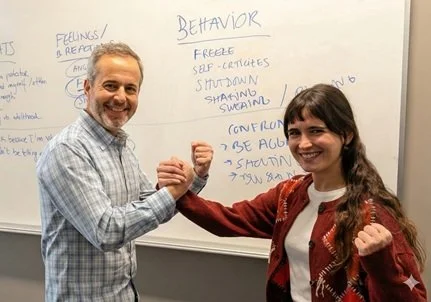
Sentio University is a California-based nonprofit graduate school offering a hybrid MA in Marriage and Family Therapy built around deliberate practice methodology. The program is approved by the California Bureau for Private Postsecondary Education (BPPE) and the California Board of Behavioral Sciences (BBS), ensuring graduates meet the educational requirements for MFT licensure in California. The program describes itself as the first MFT graduate program to integrate deliberate practice into roughly half of every class session, meaning that approximately half of each class meeting is structured around active skills rehearsal rather than lecture (Rousmaniere & Vaz, 2025). All therapy sessions conducted through the affiliated Sentio Counseling Center are video-recorded, all counselors use routine outcome monitoring with every client at every session, and all supervisors are trained through a video-based supervision training program (Rousmaniere & Vaz, 2025; Levenson, 2024) that now runs in six- and twelve-month tracks. This structure is designed to address the research finding that traditional supervision, as currently practiced, does not reliably improve client outcomes, by replacing conceptual discussion of cases with direct behavioral rehearsal and corrective feedback grounded in video evidence (Rousmaniere, Goodyear, Miller, & Wampold, 2017).
On the technology and AI side, Sentio maintains an active AI Research Team that publishes peer-reviewed research on the use of large language models in mental health contexts, including the studies cited earlier in this post. The program also offers an AI certification for therapists, designed to give clinicians a structured grounding in how AI tools function, where they are already operating in the mental health space, and how to engage with them thoughtfully as a practicing clinician. Students interested in the intersection of AI and clinical training will find that Sentio has published substantive work in this area. The combination of deliberate practice methodology and AI literacy training positions Sentio graduates for both the traditional clinical job market and the emerging technology-informed landscape.
Sentio's telehealth-first structure also reflects the current practice environment. Because the program's clinical training is conducted via telehealth and the counseling center delivers services statewide, students train in the same modality they are likely to use in the first years of professional practice. This is not the only valid model: programs with strong in-person practicum components develop different but also valuable skills. Prospective students should evaluate whether a program's training modality matches the practice setting they intend to enter.
For more information about the program's structure, curriculum, and approach, the Sentio FAQ page addresses common questions about admissions, curriculum, clinical training, and the deliberate practice methodology. Additional posts on the Sentio blog explore topics in MFT training, career development, and the intersection of technology and clinical practice in more depth.
For prospective students who want to understand the theoretical and empirical foundations of deliberate practice methodology across a range of therapeutic modalities, the APA Essentials of Deliberate Practice series, edited by Alexandre Vaz, PhD and Tony Rousmaniere, PsyD, provides a comprehensive research-grounded resource. The series covers deliberate practice applications across multiple treatment modalities and is designed to equip therapists with transferable skills that enhance employability across a range of clinical settings.
Closing: Return to Your Own Decision
The data in this post can orient your search, but it cannot make your decision for you. Job market statistics, workforce shortage data, and employer salary figures describe the environment you will enter, not the program that will prepare you best for it. Two programs can sit in the same favorable market and produce graduates with very different skill sets, clinical confidence, and readiness for independent practice. The difference lies in curriculum philosophy, how much of training is spent in active skills rehearsal versus passive learning, how closely supervision is tied to direct observation of your actual clinical work, and how seriously the program treats outcome monitoring as a feedback mechanism rather than a compliance requirement.
No marketing material, program website, or blog post, including this one, can tell you what a program actually feels like from the inside. The most reliable way to cut through the marketing and evaluate any school is to ask to observe a live or online class. Not a recorded demo, not an information session, but an actual class in session. Every program that is genuinely confident in the quality of its training should welcome this request and even encourage it. If a program is reluctant to let prospective students see how it teaches, that reluctance is itself information worth having. Whatever programs you are evaluating, ask each one if you can sit in on a class before you commit. It is one of the most useful questions you can ask, and the answer will tell you more than any statistics. To organize your evaluation across multiple programs, browse our directory of MFT programs in California.
Keep reading
How therapist licensure works in California, the full sequence from degree to license.
What a therapy career pays in California, the pay calculator for every region and setting.
MFT license requirements by state, if you might practice outside California someday.
MFT licensing in the San Francisco Bay Area, programs, supervised hours, and career paths in the Bay Area.
FAQ: MFT Job Growth and Demand in California
Is the MFT profession growing in California?
Yes. The Bureau of Labor Statistics projects 8% employment growth from 2025 to 2035 for counselors, social workers, and community and social service specialists, and California's unique combination of population size, public health investment, and structural workforce shortage positions the state to absorb more than its proportional share of that growth. Rising exam volumes and BBS registration numbers confirm that the workforce pipeline is expanding.
How many new MFT jobs are projected in California through 2035?
The BLS does not publish California-specific MFT projections as a standalone figure, but the national projection for the broader counselors, social workers, and community and social service specialists category is approximately 230,900 new jobs from 2025 to 2035. Given that California accounts for a substantial share of national mental health employment and has committed significant state funding to behavioral health workforce growth, new graduates entering the market over that period face favorable structural conditions.
Which California regions have the most MFT job openings?
Los Angeles has the highest raw number of MFT positions at approximately 10,920 (BLS, 2024), but the regions with the most acute need relative to available providers tend to be rural counties and smaller metropolitan areas. HCAI data shows that 40 of 58 California counties may need additional behavioral health providers, and 10 counties have patient-to-provider ratios exceeding 1,000 to 1. State scholarship programs specifically incentivize graduates to work in these underserved regions.
Is telehealth creating new MFT job opportunities in California?
Yes, substantially. Telehealth now accounts for more than 30% of specialty mental health sessions in California, a level that is effectively permanent. This shift expands the geographic scope of MFT practice beyond physical office locations, enabling therapists to serve clients across the state. Programs that integrate telehealth delivery into training are preparing students to enter a practice environment that is already digital by default.
How does the MFT workforce shortage affect new graduates?
The shortage benefits new graduates by creating high demand for licensed and pre-licensed therapists across a wide range of settings. With 40 of 58 California counties needing additional providers and 169 million Americans living in federal Mental Health Professional Shortage Areas nationally, new graduates face a market where supply falls meaningfully short of demand. For graduates willing to work in underserved settings, state scholarship programs provide both financial support and accelerated career entry.
What state programs support MFT workforce growth in California?
The primary state investment comes through the Department of Health Care Access and Information, which awarded $15,638,376 in scholarships to 610 behavioral health students in December 2023 alone. Programs include the Behavioral Health Scholarship Program, which provides up to $25,000 in exchange for a 12-month service commitment in an underserved area, and the Golden State Social Opportunities Program, which provides up to $50,000. HCAI is also developing the 2026-2030 Workforce Education and Training Plan to guide longer-term investment. The BBS Board of Behavioral Sciences website lists current regulatory requirements and resources at www.bbs.ca.gov.
Will AI replace MFTs or create new opportunities for the profession?
The current evidence does not support the framing that AI will replace licensed therapists. Research published in The Lancet Psychiatry notes that existing digital mental health tools, including AI-assisted apps, achieve effect sizes of approximately 0.20 to 0.30 on standardized measures, compared to approximately 0.80 for face-to-face psychotherapy (Rousmaniere, Goldberg, & Torous, 2025). The more likely trajectory is one in which AI tools become increasingly common as a first point of contact or supplementary resource, making human therapists responsible for cases of greater complexity, risk, and relational depth. Therapists who understand how AI mental health tools function and where they fall short are better positioned to navigate this landscape than those who treat AI as irrelevant to their professional development. The Sentio AI certification for therapists is one structured resource for developing that literacy.
What should I look for in an MFT program given the evolving job market?
Beyond accreditation and licensing pass rates, prospective students should ask how a program structures clinical skills development beyond lecture, how it uses client outcome data during training, what its telehealth training looks like, and how it prepares graduates for a practice environment that includes AI tools. Programs vary significantly on these dimensions, and those differences are consequential for the kind of clinician you become. The best way to evaluate these factors is not through marketing materials but through direct observation, which brings us to the final recommendation in the closing section of this post.
References
Board of Behavioral Sciences. (2024). Application for LMFT licensure (in-state). https://www.bbs.ca.gov/pdf/forms/mft/mftapp.pdf
Board of Behavioral Sciences. (2024). Licensing population report September 2024. https://www.bbs.ca.gov/pdf/board_minutes/2024/20241114-15_item9.pdf
Board of Behavioral Sciences. (2023). Exam results by quarter. https://www.bbs.ca.gov/pdf/agen_notice/2023/20230202_03_item_xv_d.pdf
Board of Behavioral Sciences. (2025). Executive officer report August 2025. https://bbs.ca.gov/pdf/agen_notice/2025/20250821_22_item_15.pdf
Board of Behavioral Sciences. (2025). Board meeting minutes August 2025. https://www.bbs.ca.gov/pdf/board_minutes/2025/202508_board_min.pdf
Department of Health Care Services. (2024). Biennial telehealth utilization report. https://www.dhcs.ca.gov/provgovpart/Documents/Biennial-Telehealth-Utilization-Report-April-2024.pdf
Goldberg, S. B., Babins-Wagner, R., Rousmaniere, T., Berzins, S., Hoyt, W. T., Whipple, J. L., Miller, S. D., & Wampold, B. E. (2016). Creating a climate for therapist improvement: A case study of an agency focused on outcomes and deliberate practice. Psychotherapy, 53(3), 367-375. https://doi.org/10.1037/pst0000060
Goldberg, S. B., Rousmaniere, T., Miller, S. D., Whipple, J., Nielsen, S. L., Hoyt, W. T., & Wampold, B. E. (2016). Do psychotherapists improve with time and experience? A longitudinal analysis of outcomes in a clinical setting. Journal of Counseling Psychology, 63(1), 1-11. https://doi.org/10.1037/cou0000131
HCAI. (2023). California supports students through $15.6 million in behavioral health scholarships. https://hcai.ca.gov/california-supports-students-through-15-6-million-in-behavioral-health-scholarships/
HCAI. (2024). Behavioral health providers, encounters, and diagnoses in California's hospital inpatient and emergency department settings. https://hcai.ca.gov/visualizations/behavioral-health-providers-encounters-and-diagnoses-in-californias-hospital-inpatient-and-emergency-department-settings/
HCAI. (2025). Behavioral health scholarship program information. https://hcai.ca.gov/workforce/financial-assistance/scholarships/bhsp/info/
HCAI. (2026). 2026-2030 WET plan development. https://hcai.ca.gov/workforce/financial-assistance/grants/bhp/
Legislative Analyst's Office. (2021). The 2021-22 budget: Analysis of the Governor's Medi-Cal telehealth proposal. https://lao.ca.gov/Publications/Report/4430
Levenson, H. (2024, May). What deliberate practice supervision has to offer traditional supervision: Nine take-home messages. Psychotherapy Bulletin, 59(3), 55-59. https://societyforpsychotherapy.org/what-deliberate-practice-supervision-has-to-offer-traditional-supervision-nine-take-home-messages/
Owen, J., Wampold, B. E., Kopta, M., Rousmaniere, T., & Miller, S. D. (2016). As good as it gets? Therapy outcomes of trainees over time. Journal of Counseling Psychology, 63(1), 12-19. https://doi.org/10.1037/cou0000112
Rousmaniere, T., Goldberg, S. B., & Torous, J. (2025). Large language models as mental health providers. The Lancet Psychiatry, 13(1), 7-9. https://doi.org/10.1016/S2215-0366(25)00269-X
Rousmaniere, T., Goodyear, R. K., Miller, S. D., & Wampold, B. E. (2017). Improving psychotherapy outcomes: Guidelines for making psychotherapist expertise development routine and expected. In T. Rousmaniere, R. K. Goodyear, S. D. Miller, & B. E. Wampold (Eds.), The cycle of excellence: Using deliberate practice to improve supervision and training (pp. 267-275). John Wiley & Sons. ISBN: 978-1-119-16556-9. https://doi.org/10.1002/9781119165590.ch13
Rousmaniere, T., & Vaz, A. (2025, March). Sentio's clinic-to-classroom method: Bridging deliberate practice and clinical training. Psychotherapy Bulletin, 60(2), 79-84. https://societyforpsychotherapy.org/sentios-clinic-to-classroom-methodbridging-deliberate-practice-and-clinical-training/
Rousmaniere, T., Zhang, Y., Li, X., & Shah, S. (2025). Large language models as mental health resources: Patterns of use in the United States. Practice Innovations. Advance online publication. https://doi.org/10.1037/pri0000292
U.S. Bureau of Labor Statistics. (2024). Occupational employment and wage statistics: Marriage and family therapists. https://www.bls.gov/oes/2023/may/oes211013.htm
U.S. Bureau of Labor Statistics. (2024). Occupational outlook handbook: Marriage and family therapists. https://www.bls.gov/ooh/community-and-social-service/marriage-and-family-therapists.htm
U.S. Bureau of Labor Statistics. (2026). Occupational projections, 2025-35, and worker characteristics, 2025 (Table 1.2). https://www.bls.gov/emp/tables/occupational-projections-and-characteristics.htm
Vaz, A., & Rousmaniere, T. (2022). Clarifying deliberate practice for mental health training. Sentio University. https://drive.google.com/file/d/1MFdWU-fRl-2EKN2rdvFsExPcJ8-O0C_A/view
Relevant Government Websites
California Board of Behavioral Sciences: https://www.bbs.ca.gov
California Department of Health Care Access and Information (HCAI): https://hcai.ca.gov
U.S. Bureau of Labor Statistics, Marriage and Family Therapists: https://www.bls.gov/ooh/community-and-social-service/marriage-and-family-therapists.htm
About the Authors
Tony Rousmaniere, PsyD is the President of Sentio University and Executive Director of the Sentio Counseling Center. He is Past-President of the psychotherapy division of the American Psychological Association and the author of over 20 books on deliberate practice and psychotherapy training, including The Essentials of Deliberate Practice book series (APA Books). He is a licensed psychologist in California and Washington. Learn more
Alexandre Vaz, PhD is the Chief Academic Officer of Sentio University and cofounder of the Deliberate Practice Institute. He is co-editor of The Essentials of Deliberate Practice book series (APA Books) and the author of over a dozen books on deliberate practice and psychotherapy training. Dr. Vaz is the founder and host of Psychotherapy Expert Talks. He is a licensed clinical psychologist in Portugal. Learn more