
2025 Study: COAMFTE MFT Programs Not Preparing Students for Clinical Practice
What Two National Research Studies Found About How Well COAMFTE-Accredited MFT Programs Prepare Students for Clinical Practice
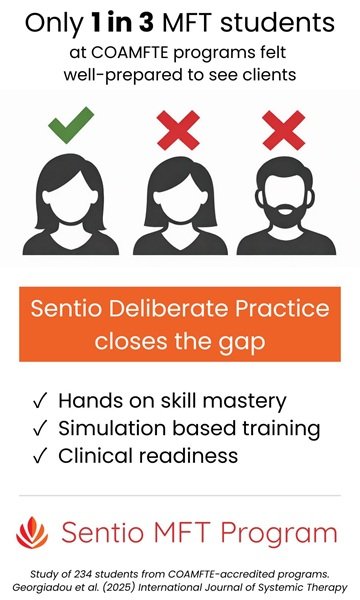
Only about one third of MFT students surveyed in a recent nationwide study felt their graduate programs had substantially prepared them across all six AAMFT core competency domains. That finding, from a 2025 mixed-methods study of 234 students enrolled in COAMFTE-accredited Master's programs, paints a sobering picture of the state of clinical training in marriage and family therapy (Georgiadou et al., 2025). What makes it more concerning is that the pattern is not new. Over a decade earlier, Steele (2013) conducted a qualitative study of post-graduate MFT supervisees and found strikingly similar results: supervisees had mastered some foundational competencies but had not mastered therapeutic interventions, legal and ethical standards, or research and program evaluation.
Taken together, these two studies suggest that the gap between what MFT students learn in the classroom and what they can actually do in a therapy room is persistent, well-documented, and not adequately resolved by standard training approaches. For prospective students evaluating MFT programs, these findings carry practical implications. The program you choose will shape not just your knowledge base but your readiness to sit with real clients, manage clinical crises, develop treatment plans under pressure, and navigate the legal and ethical complexities of practice. Whether you are just beginning to explore how to become an MFT in California or comparing programs with an eye toward salary and career outcomes, understanding the research on training quality can help you ask the right questions before you commit.
What Did the 2025 Nationwide Survey of COAMFTE MFT Students Find?
Georgiadou, Hicks, Cuthbertson, and Cooper (2025) surveyed 234 graduate students currently enrolled in practicum or internship courses at COAMFTE-accredited Master's programs across the United States. The study used a mixed-methods design, combining Likert-scale ratings of perceived preparation across the six AAMFT core competency domains with open-ended qualitative questions about critical incidents, skill gaps, and comfort levels with specific clinical tasks.
The quantitative results revealed that across all six competency domains, only about 29% to 35% of students rated their program's help as "substantial." The domains where students most frequently reported receiving no preparation at all were treatment planning and case management (7%), therapeutic intervention (6%), and legal issues and ethics (6%). These are not peripheral topics. They represent the clinical activities that MFTs perform every day in practice.
The study also found significant demographic disparities in perceived preparation. Students of color were significantly less likely than white students to rate their programs as providing substantial help in clinical assessment and diagnosis, treatment planning, and legal and ethical issues. Female and gender non-conforming students reported lower levels of perceived preparation than male students in legal and ethical issues and research and program evaluation. Part-time students were more likely than full-time students to feel unprepared in treatment planning and therapeutic intervention. These findings suggest that the theory-practice gap does not affect all students equally, and that program design choices around scheduling, delivery, and pedagogy may have equity implications.
Program delivery format mattered as well. Students in online-only programs were significantly more likely to report feeling unprepared in admission to treatment and legal and ethical issues. Hybrid students (those in programs combining online and in-person elements) consistently reported the highest levels of perceived preparation, outperforming both online-only and in-person-only peers across multiple domains. Prospective students weighing hybrid versus in-person MFT programs may find this pattern relevant to their decision-making.
The qualitative findings added texture to the numbers. When asked to describe skills they felt least comfortable applying, students most frequently mentioned treatment planning and case management, followed by clinical assessment and diagnosis, and then legal issues, ethics, and standards. Students reported uncertainty about creating effective treatment plans, difficulty applying diagnostic criteria accurately, confusion about mandatory reporting obligations, and a lack of preparation for crisis intervention and intimate partner violence cases. One participant described receiving conflicting guidance about mandatory reporting from different supervisors, while another reported feeling unprepared to manage co-therapy dynamics in a high-conflict family case.
In contrast, when asked about skills they felt most comfortable applying, students named specific evidence-based techniques: cognitive-behavioral therapy, dialectical behavior therapy, motivational interviewing, mindfulness-based practices, trauma-informed care, and solution-focused therapy. The skills students felt confident using were largely technique-specific and model-driven. The skills they felt least confident using were the broader clinical judgment capacities that require integration of knowledge across domains under real-time clinical pressure. This distinction maps directly onto the difference between declarative knowledge and procedural knowledge, a concept the study authors highlight as central to the training problem.
A key takeaway from the study is that students consistently valued experiential learning, including roleplays, mock sessions, and collaborative practice with peers and supervisors, as the most important contributors to their skill development. Students who had opportunities to observe experienced therapists, practice interventions in structured exercises, and receive specific corrective feedback reported greater confidence in clinical application. For more information about training methodologies designed around this principle, see our page on what deliberate practice is and how it works. For answers to common questions about MFT training, visit the Sentio FAQ page.
Table 1: Key Findings from Georgiadou et al. (2025)
| Finding | Detail |
|---|---|
| Sample | 234 students from U.S. COAMFTE-accredited Master's MFT programs, all currently in practicum or internship |
| Students feeling substantially prepared | Approximately 29% to 35% across the six AAMFT competency domains |
| Biggest competency gaps reported | Treatment planning and case management, therapeutic intervention, and legal issues and ethics |
| Skills students felt most comfortable with | Evidence-based techniques: CBT, DBT, motivational interviewing, mindfulness, trauma-informed care, solution-focused therapy |
| Racial disparities | Students of color rated programs as providing significantly less help in assessment/diagnosis, treatment planning, and legal/ethical issues |
| Delivery format finding | Hybrid students reported the highest preparation ratings; online-only students reported the lowest in multiple domains |
| Most valued training element | Experiential learning: roleplays, mock sessions, collaborative practice with peers and supervisors |

What Did the 2013 Study of MFT Post-Graduate Supervisees Find?
Over a decade before the Georgiadou et al. survey, Steele (2013) conducted a qualitative phenomenological study exploring MFT supervisees' perspectives on postgraduate supervision and the acquisition of AAMFT core competencies. The study used Moustakas' modified van Kaam method to analyze transcribed phone interviews with 11 graduates of a COAMFTE-accredited master's program in the Southeastern United States. All participants were completing postgraduate supervised experience toward licensure, placing them at a critical juncture between graduate training and independent practice.
Five emergent themes were identified: supervisee growth, supervisor characteristics, core competencies, administrative versus clinical supervision, and the overall supervision experience. On the question of which core competencies supervisees had mastered, the findings drew a clear dividing line. Participants reported having mastered admission to treatment, clinical assessment and diagnosis, and treatment planning and case management. These are the competencies most directly tied to structured, procedural clinical tasks that programs tend to teach explicitly through coursework and supervised practice.
The competencies that supervisees had not mastered were therapeutic interventions, legal issues, ethics, and standards, and research and program evaluation. These are the domains that require more complex clinical judgment, real-time decision-making, and the integration of multiple knowledge areas under conditions of uncertainty. The parallel with the 2025 Georgiadou et al. findings is striking. Although the studies used different methods, different samples, and were conducted over a decade apart, the same domains emerged as the persistent weak points in MFT training. For prospective students researching MFT program options, this convergence is worth taking seriously.
Steele's study also yielded important findings about the role of supervision quality. Participants described the supervisory relationship as the primary mechanism through which competencies were either acquired or neglected. The quality of that relationship depended heavily on the supervisor's personality, theoretical orientation match, and willingness to provide genuine clinical (rather than purely administrative) supervision. Several participants described supervision experiences that were predominantly administrative, focused on paperwork, billing, and caseload management, with little attention to clinical skill development. Others described transformative supervisory relationships in which feedback was specific, supportive, and directly tied to clinical growth. For a deeper exploration of what distinguishes effective supervision from inadequate supervision, see our resource on evaluating MFT supervision quality.
The study recommended that supervisees take an active role in selecting supervisors whose theoretical orientation and interpersonal style match their learning needs, that supervisors structure supervision sessions with awareness that new therapists may lack confidence and need scaffolded support, and that graduate programs better prepare students for the realities of managed care and post-degree practice environments. Students navigating the California MFT licensure requirements will encounter these supervision dynamics firsthand during the 3,000 hours of postgraduate supervised experience.
Table 2: Key Findings from Steele (2013)
| Finding | Detail |
|---|---|
| Sample and method | Qualitative phenomenological study of 11 graduates from a COAMFTE-accredited master's program, interviewed by phone during postgraduate supervision |
| Competencies mastered | Admission to treatment, clinical assessment and diagnosis, treatment planning and case management |
| Competencies not mastered | Therapeutic interventions, legal issues/ethics/standards, and research and program evaluation |
| Supervision quality | The supervisory relationship was positive or negative based largely on supervisor personality, theoretical match, and willingness to provide clinical (not just administrative) supervision |
| Administrative vs. clinical supervision | Several participants described supervision focused on paperwork and billing rather than clinical skill development |
| Key recommendations | Supervisees should actively select supervisors who match their learning needs; educational programs should better prepare students for post-degree clinical realities |
What Do These Studies Tell Us About the Theory-Practice Gap in COAMFTE MFT Education?
The convergence of findings across these two studies, separated by over a decade of time and using entirely different methodologies, points to a structural problem in MFT education rather than an isolated shortcoming of any individual program. The domains where students and supervisees consistently report feeling least prepared are not random. They are the domains that require the most complex clinical judgment: therapeutic intervention (deciding what to do in the moment with a client in distress), legal and ethical reasoning (navigating ambiguous situations where multiple obligations compete), and treatment planning (translating assessment into a coherent, actionable course of therapy). These are also the domains least amenable to traditional lecture-based instruction.
Georgiadou et al. (2025) explicitly frame this pattern in terms of the distinction between declarative and procedural knowledge, drawing on Blow, Seedall, Miller, Rousmaniere, and Vaz (2022). Declarative knowledge is what a person can understand, discuss, or write about. It is acquired relatively quickly through reading, lecture, and discussion. Procedural knowledge is what a person can actually perform, especially under conditions of stress and uncertainty. It is acquired slowly, through repetition, feedback, and guided practice. The theory-practice gap in MFT education is, at its core, a gap between declarative and procedural learning. Students can discuss family therapy models, cite diagnostic criteria, and articulate ethical principles. What many cannot yet do is apply those concepts fluently when sitting across from a distressed family, a suicidal adolescent, or a couple in crisis.
Both studies also highlight the critical role of experiential learning and supervision quality. Georgiadou et al. found that students who had access to structured experiential practice, including roleplays, mock sessions, and observation of experienced clinicians, reported greater confidence and more specific skill application. Steele found that the supervisory relationship was the primary vehicle through which competencies were either developed or left undeveloped. These findings align with a broader body of research on deliberate practice and therapist development showing that clinical experience alone does not reliably improve therapist effectiveness. In a landmark longitudinal study of 170 therapists treating 6,591 patients, Goldberg, Rousmaniere, Miller, Whipple, Nielsen, Hoyt, and Wampold (2016) found that therapists on average showed a slight decline in client outcomes as experience accumulated, though 39% of therapists did improve over time. The implication is that experience without structured feedback and skill-focused practice is not a reliable path to competence.
What Should Prospective MFT Students Look for in a Training Program?
The findings from these two studies translate into a set of practical questions that prospective students can use when evaluating MFT programs.
First, ask how the program balances lecture-based instruction with structured skills practice. Programs that dedicate substantial class time to behavioral rehearsal, roleplay, and skill-building exercises are more likely to develop procedural competence than programs that rely primarily on readings, discussion, and written assignments. The Georgiadou et al. (2025) finding that students consistently valued experiential learning above other training elements suggests this is not a matter of student preference alone. It reflects a genuine pedagogical difference in how effectively knowledge is converted into skill.
Second, ask about the timing and structure of practicum. In some programs, students begin clinical work in their first year with concurrent coursework and supervision. In others, practicum is delayed until the second or third year, creating a gap between theoretical instruction and clinical application. Georgiadou et al. noted that the absence of concurrent knowledge-focused coursework and practice courses in the first year may contribute to heightened anxiety and diminished readiness when students finally begin seeing clients.
Third, ask about supervision methodology. Is supervision video-based? Are supervisors trained in a specific, structured supervision model, or is supervision conducted informally based on individual supervisors' personal preferences? Steele (2013) found that supervision quality varied enormously and that the supervisory relationship was the single most important factor in whether competencies were acquired. Research cited in Rousmaniere's foundational text on deliberate practice found that fewer than 5% of supervisees reported that their supervisors regularly engaged in explicit collaborative supervision (Rousmaniere, 2017, p. 34, citing Rousmaniere and Ellis, 2013). This is a question worth asking directly.
Fourth, ask whether the program uses feedback-informed treatment and routine outcome monitoring. Programs that require trainees to track client progress session by session develop a professional habit of accountability that aligns with the growing expectation in clinical settings for data-informed practice. Programs that do not use outcome monitoring may leave graduates without this skill at a time when employers, insurers, and school systems increasingly require it.
Fifth, consider the delivery format carefully. The Georgiadou et al. (2025) finding that hybrid students reported the highest levels of perceived preparation, outperforming both online-only and in-person-only peers, is notable. It suggests that a combination of in-person skills practice and the flexibility of online learning may offer advantages over either format alone. For a structured way to compare programs across these dimensions, try our MFT program comparison tool.
How Does Deliberate Practice Address the Theory-Practice Gap? A Closer Look at Sentio University
The problems documented in these two studies map directly onto the training challenge that deliberate practice methodology was designed to solve. Deliberate practice, as developed by K. Anders Ericsson and adapted for psychotherapy by Tony Rousmaniere, PsyD, and Alexandre Vaz, PhD, is a structured approach to skill development built on repetition of specific clinical tasks, real-time corrective feedback, and progressive difficulty calibration. Its core premise is that expertise in complex performance domains, including psychotherapy, does not emerge from experience alone. It requires targeted, effortful practice of the specific skills that matter most, with feedback that is specific enough to guide improvement.
According to Rousmaniere and Vaz (2025), "many graduate programs produce students who can talk or write about therapy quite adeptly yet still struggle to perform therapy optimally. This gap is precisely what deliberate practice aims to fill by consolidating declarative knowledge into procedural skill" (p. 3). This observation aligns precisely with what both the Georgiadou et al. and Steele studies found: students acquire declarative knowledge of clinical concepts but struggle to translate that knowledge into reliable clinical performance under real-world conditions.
Sentio University, a nonprofit graduate institution in Los Angeles offering a hybrid Master of Arts in Marriage and Family Therapy, was founded explicitly to address this problem. The program is built around deliberate practice methodology, with roughly half of nearly every class session dedicated to active skills training rather than lecture. Rousmaniere and Vaz (2025) describe it as the first graduate psychotherapy program to integrate deliberate practice at this scale. The pedagogical structure is designed to ensure that students are not merely learning about therapy. They are practicing therapy skills repeatedly, receiving specific behavioral feedback, and building the procedural competence that traditional programs often leave to practicum and post-degree supervision to develop. The MFT credential's distinctive strength in systemic and relational work, which differentiates it from other mental health licensure pathways as discussed in our comparison of MFT versus LCSW career paths, makes this hands-on training approach particularly valuable. Relational and systemic clinical skills are difficult to develop through lecture alone.
The specific competency gaps identified in both studies are addressed through several interlocking elements of Sentio's training model.
Treatment planning and therapeutic intervention gaps. Both studies found that treatment planning and therapeutic intervention were among the domains where students felt least prepared. In a traditional curriculum, students learn about treatment planning through readings and written assignments, then attempt to apply it in practicum. At Sentio, the classroom itself functions as an active training ground. Students practice treatment planning and intervention skills through structured behavioral rehearsal exercises during class, receive immediate corrective feedback from faculty, and then continue practicing the same skills through assigned homework requiring a minimum of 10 minutes of solo practice per skill (Levenson, 2024). This cycle of practice, feedback, and repetition is the mechanism through which declarative knowledge becomes procedural skill. For more about how deliberate practice works in psychotherapy training, see our dedicated overview.
Supervision quality gaps. Both studies highlighted supervision quality as a decisive factor in competency acquisition. Steele (2013) found that the difference between productive and unproductive supervision lay in the supervisor's approach, not just their credentials. Rousmaniere (2017) documented that 84% of trainees withhold information from their supervisors and that fewer than 5% of supervisees reported regularly receiving explicit collaborative supervision. At Sentio, supervisors complete a rigorous 50-week video-based supervision training program before supervising students (Rousmaniere and Vaz, 2025). All therapy sessions at the Sentio Counseling Center practicum are videotaped, all counselors use routine outcome monitoring every session with every client, and all supervision sessions are also recorded for review. This level of transparency and structure directly addresses the supervision quality problems both studies identified.
Hanna Levenson, PhD, a psychotherapy training expert who observed Sentio's Supervision-of-Supervision meetings over a year and a half, documented nine key lessons from the model. Among her observations: "In the past, I have written about how supervision has been the most closeted component of psychotherapy training. No one records or shows their supervision sessions. In these Sup-of-Sup meetings, however, the door is thrown wide open!" (Levenson, 2024, p. 2). She also noted the model's emphasis on behavioral rehearsal beginning at the halfway point of every supervision session, ensuring that supervision is not just a conversation about therapy but a structured practice of therapy skills.
Assessment, diagnosis, and crisis intervention gaps. Students in the Georgiadou et al. study reported feeling unprepared for complex diagnostic situations, crisis intervention, and intimate partner violence cases. These are exactly the kinds of high-acuity clinical situations where the gap between declarative knowledge and procedural skill is most dangerous. Sentio's practicum integrates routine outcome monitoring into every clinical session, providing trainees with ongoing data about whether their clients are improving, deteriorating, or staying the same. This practice of systematically tracking outcomes trains students to catch deteriorating cases early, a skill that research has shown most therapists lack even after years of practice (Rousmaniere, 2017).
The hybrid delivery advantage. The Georgiadou et al. (2025) finding that hybrid students reported the highest levels of perceived preparation across multiple competency domains aligns with Sentio's program structure. The Sentio MFT program uses a hybrid format, combining online coursework with in-person clinical practice, supervision, and skills training at the Sentio Counseling Center in Los Angeles. This format allows the flexibility of remote learning for didactic content while preserving the in-person, hands-on elements that both studies identified as most critical to skill development.
External evidence for the deliberate practice approach. The claim that deliberate practice improves clinical outcomes is not based on Sentio's model alone. In a case study of a community mental health agency that combined routine outcome monitoring with deliberate practice and ongoing consultation over seven years, Goldberg, Babins-Wagner, Rousmaniere, Berzins, Hoyt, Whipple, Miller, and Wampold (2016) found that therapist effectiveness measurably improved at a rate of d = 0.035 per year, and that individual therapists' own caseload outcomes improved at d = 0.034 per year. Critically, this improvement was attributable to therapists actually developing their skills, not to the agency hiring better therapists over time. In a separate longitudinal study, Owen, Wampold, Kopta, Rousmaniere, and Miller (2016) found that therapy trainees showed small but positive growth in client outcomes (d = 0.04 per year), but that this growth was entirely limited to less-distressed clients. Trainees showed no improvement in their ability to help more severely distressed clients across their entire training period, a finding that underscores the need for training approaches that push beyond basic skill acquisition.
The Essentials of Deliberate Practice book series. The APA Essentials of Deliberate Practice series, co-edited by Alexandre Vaz, PhD, and Tony Rousmaniere, PsyD, now includes over 16 volumes covering specific therapeutic modalities. Volumes such as Deliberate Practice in Systemic Family Therapy (Blow, Seedall, Miller, Rousmaniere, and Vaz, 2022) provide structured skill-building exercises in the family-focused, relationally complex interventions that MFTs use most. These volumes are integrated directly into Sentio's curriculum, providing students with a structured pathway for converting model-specific theory into practiced, rehearsed, and feedback-informed clinical skill.
It should be noted that Sentio University is a relatively young institution. Its first cohort completed the program with a graduation ceremony in May 2026. Students researching any new program should evaluate accreditation status, clinical placement networks, and faculty credentials alongside stated pedagogical approach. No single program is the right fit for every student, and the competency gaps documented in the Georgiadou et al. and Steele studies can be addressed through a variety of training models. What both studies make clear, however, is that the traditional lecture-and-practicum approach leaves a substantial proportion of students feeling unprepared, and that programs incorporating structured experiential practice, high-quality supervision, and ongoing skills development are better positioned to close that gap. For more information about Sentio's approach, visit the request information page.

Frequently Asked Questions
What percentage of MFT students feel well-prepared by their COAMFTE-accredited training programs?
According to a 2025 nationwide survey of 234 students at COAMFTE-accredited Master's MFT programs, only about 29% to 35% of students rated their program's help as "substantial" across the six AAMFT core competency domains (Georgiadou et al., 2025). The domains with the lowest substantial preparation ratings were clinical assessment and diagnosis (29%), legal issues and ethics (30%), and treatment planning and case management (31%). These findings suggest that roughly two thirds of MFT students feel their programs provided only some, little, or no help in building applied clinical competence. For more context on what to look for in a training program, see the Sentio MFT program overview.
What clinical skills do MFT students report the most difficulty applying?
The Georgiadou et al. (2025) study found that the skills students felt least comfortable applying fell into three main categories: treatment planning and case management (the most frequently cited gap), clinical assessment and diagnosis, and legal issues, ethics, and standards. Students specifically reported uncertainty about creating effective treatment plans, difficulty applying diagnostic criteria accurately, confusion about mandatory reporting obligations, and a lack of preparation for crisis intervention and intimate partner violence cases. Students also reported difficulty maintaining therapeutic alliance with multiple family members simultaneously, a skill central to the MFT scope of practice. Training approaches that include structured behavioral rehearsal, such as those described on our deliberate practice exercises page, are designed to build these procedural skills.
Does program delivery format affect how well COAMFTE MFT students feel prepared?
Yes. The Georgiadou et al. (2025) study found a significant association between program delivery format and perceived preparation. Students in hybrid programs (combining online and in-person elements) consistently reported the highest levels of perceived preparation, outperforming both online-only and in-person-only peers. Online-only students were notably more likely to report receiving no preparation in legal issues and ethics (20% reported "none") and were less prepared in admission to treatment. These findings suggest that a hybrid format combining the flexibility of online learning with in-person clinical practice and supervision may offer advantages for skill development. For more on this topic, see our post on hybrid versus in-person MFT programs.
What is deliberate practice and how does it address MFT training gaps?
Deliberate practice is a structured approach to skill development, originally identified by researcher K. Anders Ericsson, that involves repetitive rehearsal of specific skills with real-time corrective feedback and progressive difficulty calibration. In the context of MFT training, deliberate practice converts declarative knowledge (what students can discuss or write about) into procedural knowledge (what they can perform under clinical pressure) through behavioral rehearsal exercises, video review, and guided practice with real clinical material. Research has shown that therapists who engaged in deliberate practice achieved client outcomes at nearly three times the rate of other therapists (Rousmaniere, 2019, citing Chow et al., 2015). For a full explanation, visit What is Deliberate Practice? on the Sentio University website.
How can I evaluate whether a COAMFTE-accredited MFT program will prepare me for clinical practice?
Based on the findings from both the Georgiadou et al. (2025) and Steele (2013) studies, prospective students should ask five key questions: (1) How much class time is dedicated to structured skills practice versus lecture? (2) When does practicum begin, and is it concurrent with coursework? (3) Is supervision video-based, and are supervisors trained in a specific supervision methodology? (4) Does the program use routine outcome monitoring in its clinical training? (5) What is the program's delivery format, and does it include in-person skills training components? The most reliable way to evaluate any program is to ask to observe a live class or online session with current students before committing. For a structured comparison framework, use our MFT program comparison tool.
What is the theory-practice gap in MFT education?
The theory-practice gap refers to the disconnect between what MFT students learn in the classroom (theories, models, diagnostic criteria, ethical principles) and what they can actually do when sitting with real clients. Both the Georgiadou et al. (2025) and Steele (2013) studies found that MFT students and recent graduates reported mastering the conceptual foundations of clinical work but struggling to apply those concepts under the uncertainty and pressure of real clinical encounters. This gap has been documented across helping professions including nursing, social work, and counselor education. What distinguishes programs that close this gap is the integration of structured experiential learning, high-quality supervision, and ongoing skills development into the training model. For more about how one program approaches this challenge, see our page on deliberate practice in MFT training.
References
Blow, A., Seedall, R., Miller, D., Rousmaniere, T., and Vaz, A. (2022). Deliberate practice in systemic family therapy (Essentials of deliberate practice). American Psychological Association. ISBN: 978-1-4338-3774-6.
Georgiadou, S., Hicks, A. A., Cuthbertson, C. L., and Cooper, J. (2025). Master's students' perceptions of their marriage and family therapy training: Findings from a U.S. nationwide survey exploring core competencies. International Journal of Systemic Therapy. https://doi.org/10.1080/2692398X.2025.2492853
Goldberg, S. B., Babins-Wagner, R., Rousmaniere, T., Berzins, S., Hoyt, W. T., Whipple, J. L., Miller, S. D., and Wampold, B. E. (2016). Creating a climate for therapist improvement: A case study of an agency focused on outcomes and deliberate practice. Psychotherapy, 53(3), 367-375. https://doi.org/10.1037/pst0000060
Goldberg, S. B., Rousmaniere, T., Miller, S. D., Whipple, J., Nielsen, S. L., Hoyt, W. T., and Wampold, B. E. (2016). Do psychotherapists improve with time and experience? A longitudinal analysis of outcomes in a clinical setting. Journal of Counseling Psychology, 63(1), 1-11. https://doi.org/10.1037/cou0000131
Levenson, H. (2024). What deliberate practice supervision has to offer traditional supervision: Nine take-home messages. Psychotherapy Bulletin, 59(3), 55-59. https://societyforpsychotherapy.org/what-deliberate-practice-supervision-has-to-offer-traditional-supervision-nine-take-home-messages/
Owen, J., Wampold, B. E., Kopta, M., Rousmaniere, T., and Miller, S. D. (2016). As good as it gets? Therapy outcomes of trainees over time. Journal of Counseling Psychology, 63(1), 12-19. https://doi.org/10.1037/cou0000112
Rousmaniere, T. (2017). Deliberate practice for psychotherapists: A guide to improving clinical effectiveness. Routledge. ISBN: 978-1-138-20320-4. https://www.routledge.com/Deliberate-Practice-for-Psychotherapists
Rousmaniere, T. (2019). Mastering the inner skills of psychotherapy: A deliberate practice manual. Gold Lantern Press. ISBN: 978-1-7325657-0-8. https://www.amazon.com/Mastering-Inner-Skills-Psychotherapy-Deliberate/dp/1732565708
Rousmaniere, T., and Vaz, A. (2025). Sentio's clinic-to-classroom method: Bridging deliberate practice and clinical training. Psychotherapy Bulletin, 60(2), 79-84. https://societyforpsychotherapy.org/sentios-clinic-to-classroom-methodbridging-deliberate-practice-and-clinical-training/
Steele, S. J. (2013). Exploring marriage and family therapy supervisees' perspectives about postgraduate supervision and the acquisition of core competencies [Doctoral dissertation, Northcentral University]. ProQuest LLC. https://eric.ed.gov/?id=ED556030
Vaz, A., and Rousmaniere, T. (2022). Clarifying deliberate practice for mental health training. Sentio University. https://drive.google.com/file/d/1MFdWU-fRl-2EKN2rdvFsExPcJ8-O0C_A/view
About the Authors
Tony Rousmaniere, PsyD is the President of Sentio University and Executive Director of the Sentio Counseling Center. He is Past-President of the psychotherapy division of the American Psychological Association and the author of over 20 books on deliberate practice and psychotherapy training, including The Essentials of Deliberate Practice book series (APA Books). He is a licensed psychologist in California and Washington. Learn more
Alexandre Vaz, PhD is the Chief Academic Officer of Sentio University and cofounder of the Deliberate Practice Institute. He is co-editor of The Essentials of Deliberate Practice book series (APA Books) and the author of over a dozen books on deliberate practice and psychotherapy training. Dr. Vaz is the founder and host of Psychotherapy Expert Talks. He is a licensed clinical psychologist in Portugal. Learn more