

Deliberate Practice in Motivational Interviewing
A free training from Sentio University, co-authored by Robert Scholz, Tony Rousmaniere, and Alexandre Vaz.
Motivational interviewing is harder to learn than it looks. The vocabulary is small (open questions, affirmations, reflections, summaries), but the moment-to-moment work of recognizing change talk, choosing the right reflection, and resisting the righting reflex is built on hundreds of micro-decisions per session. This page collects Sentio University's free deliberate practice resources for clinicians using MI: a full webinar with Robert Scholz, a longtime member of the Motivational Interviewing Network of Trainers (MINT), in dialogue with Tony Rousmaniere and Alexandre Vaz. The recording is unedited, free to share, and designed to be paired with a real supervisor or study partner.
Join the email list for free training tools
What you will learn
This training is structured around five concrete skill targets that supervisors and peer practice groups can rehearse together.
- How to recognize change talk and sustain talk as they emerge in real time
- How to use complex reflections to deepen instead of redirect
- How to roll with discord without slipping into the righting reflex
- How to fit MI skill-building into your existing supervision rhythm or fidelity coaching
- How senior MI trainers think about teaching the spirit of MI to early-career therapists
Watch the webinar
Deliberate Practice in Motivational Interviewing, with Robert Scholz, Tony Rousmaniere, and Alexandre Vaz. Free to share.
This webinar accompanies the APA book Deliberate Practice in Motivational Interviewing by Manuel, Ernst, Vaz, and Rousmaniere, part of The Essentials of Deliberate Practice series. The book contains the full set of exercises that the webinar above demonstrates. Buy on Amazon.
Watch the Practice Time episodes
Going deeper: Deliberate Practice Supervision
The webinar above demonstrates what deliberate practice looks like inside MI. Doing deliberate practice supervision well is a separate skill, and one that is hard to acquire from didactic content alone. The method has to be practiced under feedback, the same way the clinical skill itself does. A single weekend workshop tends not to give supervisors enough repetitions to develop the experiential muscle they need. Sentio runs an intensive six- or twelve-month clinical supervisor training built around this principle. For the longer rationale for that format, see Why One Weekend Supervisor Trainings Fall Short.
About the authors
Robert Scholz, LMFT, LPCC is dually licensed in California as a Marriage and Family Therapist and Professional Clinical Counselor with 25 years of clinical and leadership experience across university, community mental health, forensic, and private practice settings. He is a member of the Motivational Interviewing Network of Trainers (MINT) and has served as a long-running MI trainer on a homelessness mental health treatment project in Los Angeles. His current company, The Change Place, provides psychotherapy, training, and consultation services nationally.
Tony Rousmaniere, PsyD is the President of Sentio University and Executive Director of the Sentio Counseling Center. He is past-president of the psychotherapy division of the American Psychological Association and the author of over 20 books on deliberate practice and psychotherapy training, including The Essentials of Deliberate Practice book series (APA Books).
Alexandre Vaz, PhD is the Chief Academic Officer of Sentio University and co-founder of the Deliberate Practice Institute. He is co-editor of The Essentials of Deliberate Practice book series (APA Books) and host of Psychotherapy Expert Talks.
Related Sentio resources
- Return to the Innovation Lab hub
- Clinical Supervisor Training
- Join the DP Consultation Group
- Considering graduate training? See the Sentio MFT Program
About the book
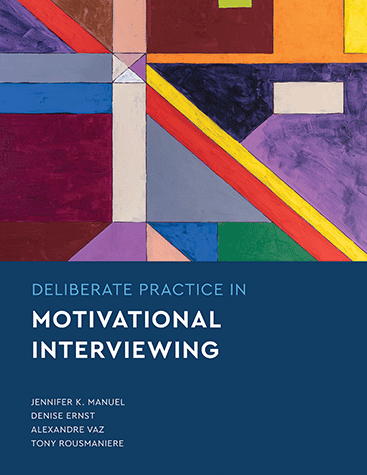
Deliberate practice exercises allow students and trainees to rehearse foundational motivational interviewing skills so they can build competence and respond effectively to diverse, complex clinical presentations.
See the full table of contents at APA Books.
Frequently asked questions
What is deliberate practice in motivational interviewing?
Deliberate practice in MI is structured, repetitive rehearsal of specific clinical skills, such as recognizing and responding to change talk, using complex reflections, rolling with resistance, and embodying the spirit of MI, with feedback from a peer or supervisor. It differs from didactic learning because the therapist actually practices the skill under simulated conditions rather than only studying or discussing it.
Who is this training for?
Licensed clinicians, supervisors, and graduate students who already have some exposure to MI and want a practical method for building their experiential skills. It is also useful for supervisors who want to introduce deliberate practice into existing group supervision or MI fidelity coaching.
Do I need to be a MINT trainer to use these exercises?
No. The exercises are designed to be useful at multiple training levels. Therapists earlier in their MI journey tend to get the most value from reflection and OARS drills. More advanced clinicians can use exercises that integrate complex reflections, evoking change talk, and softening sustain talk.
Is the webinar really free?
Yes. The webinar is free, unedited, and free to share with colleagues, students, and supervisees. Sentio University is a 501(c)(3) nonprofit and releases its training resources openly.
How is this different from a standard MI workshop?
Standard MI workshops teach the model. Deliberate practice trains the skill. The two are complementary. This webinar shows how to add rehearsal-based skill building to the training pathways most clinicians already use, including MINT training and ongoing fidelity coaching.