

Systemic Therapy
Systemic and family therapy skills are difficult to rehearse alone because the clinical unit is the whole family in the room. The therapist has to track multiple alliance threads at once, hold position when one family member tries to recruit them against another, and de-escalate live conflict without taking sides. None of that is learnable purely by reading; the moves have to be practiced under feedback. This page collects Sentio University's free Practice Time! deliberate practice demonstrations for systemic therapists. Pair them with peer practice or a structured supervision hour. For the full Practice Time! catalog across all therapy models, see the Practice Time! series page. Therapists training in family work as part of a graduate program can explore the Sentio MFT Program, the first hybrid MFT program in California to integrate deliberate practice across the entire curriculum. Licensed supervisors who want to use deliberate practice in their own supervision can join the six- or twelve-month Clinical Supervisor Training.
Watch the Practice Time episodes
Ep 15: Systemic De-escalation
Ep 14: Systemic Boundaries
Ep 13: Avoiding Triangulation
What you will learn
These three Practice Time! episodes are organized around skills that show up in nearly every family or couples session:
- How to refuse triangulation when one family member tries to recruit the therapist against another
- How to hold a boundary that protects the work without rupturing the alliance with any one family member
- How to de-escalate live conflict in the room without taking sides
- How to maintain a multi-directional alliance while still naming hard things
- How to pause an escalating exchange and redirect without losing therapeutic frame
About the book
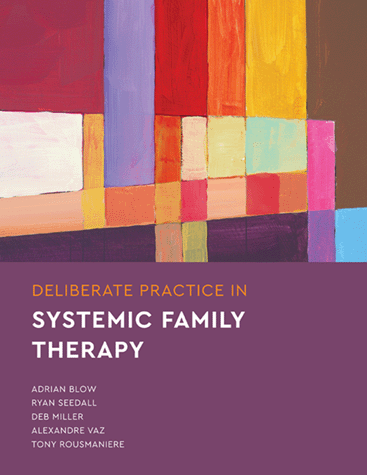
Deliberate practice exercises allow students and trainees to rehearse systemic family therapy skills so they can build competence and respond effectively to diverse, complex clinical presentations.
Exercises in this book:
- Providing a Systemic Rationale for Treatment
- Building the Therapeutic Alliance: Establishing Bonds and Joining the System
- Reframing the Problem
- Interactional Structuring: Deescalation
- Avoiding Triangulation
- Highlighting Boundaries
- Systemic Questions: Fostering Perspective Taking
- Engendering Hope
- Attention to Diversity
- Building the Therapeutic Alliance: Establishing Therapeutic Goals
- Tracking the Interactional Cycle
- Interactional Structuring: Initiating Enactments
- Annotated Systemic Family Therapy Practice Session Transcript
- Mock Systemic Family Therapy Session
Frequently asked questions
What is deliberate practice in systemic therapy?
Deliberate practice in systemic therapy is the structured rehearsal of specific clinical skills, like holding boundaries, de-escalating conflict, and avoiding triangulation, under feedback from a supervisor or peer. It is a complement to, not a replacement for, traditional family therapy supervision. For a longer introduction, see What is Deliberate Practice.
Who is this content for?
Marriage and family therapists, licensed clinical social workers, counselors, and trainees who work with families, couples, and other relational systems.
Are the Practice Time! episodes really free?
Yes. Every Practice Time! episode is free to watch on YouTube and is embedded on Sentio resource pages with no login required. The series is sponsored by Sentio University as part of the wider Free Therapist Training initiative.
How do I use these videos in supervision?
Watch one episode in a peer practice group or supervision hour, pause at the demonstrated skill, and rehearse it live in roles. One person plays the therapist, others play family members, and a third observes and gives structured feedback against the named target. For supervisors who want a deeper grounding in the method itself, see the Clinical Supervisor Training.
Is there a Sentio graduate program that uses deliberate practice in family therapy?
Yes. The Sentio MFT Program is the first hybrid Marriage and Family Therapy program in California to integrate deliberate practice across the entire curriculum.
Selected references
- Minuchin, S. (1974). Families and Family Therapy. Harvard University Press. ISBN 978-0674292369.
- Bowen, M. (1978). Family Therapy in Clinical Practice. Jason Aronson. ISBN 978-0876687611.
- Nichols, M. P. and Davis, S. D. (2020). Family Therapy: Concepts and Methods (12th ed.). Pearson. ISBN 978-0134786452.
- Rousmaniere, T., Goodyear, R. K., Miller, S. D., and Wampold, B. E. (Eds.). (2017). The Cycle of Excellence: Using Deliberate Practice to Improve Supervision and Training. Wiley-Blackwell. ISBN 978-1119165569.