
How to Increase Your MFT Salary in California in 2026: Evidence-Based Strategies for Career and Income Growth
How to Increase Your MFT Salary in California: Evidence-Based Strategies for Career and Income Growth
Research-Backed Approaches to Earning More as a Marriage and Family Therapist in California
Marriage and Family Therapists in California earn between $57,820 and $109,130 annually depending on geography; nationally, average pay ranges between $67,150 and $89,000 depending on work setting, according to the U.S. Bureau of Labor Statistics (BLS, 2024). But salary range data alone tells an incomplete story. The most powerful determinant of long-term income growth for MFTs may not be location or employer type; it may be clinical effectiveness. Research consistently shows that the most effective therapists produce 50% better client outcomes and 50% fewer dropouts than average practitioners (Rousmaniere, Goodyear, Miller, & Wampold, 2017). Therapists who improve their skills through structured deliberate practice, routine outcome monitoring, and accurate self-assessment are better positioned to sustain a caseload, earn referrals, advance into leadership roles, and justify higher reimbursement rates in every setting. This post reviews what the evidence says about the major drivers of MFT salary in California in 2026, and what prospective and early-career therapists can do to build a career that grows over time.
Last updated: September 2026
What Factors Most Influence MFT Salary in California?
Three primary drivers shape MFT compensation in California: geographic location, work setting, and clinical effectiveness. Geographic variation in California is striking. According to BLS data, mean annual wages for MFTs range from $57,820 in the Oxnard-Thousand Oaks-Ventura area to $109,130 in Vallejo-Fairfield, $92,370 in the San Francisco-Oakland-Hayward metro, $86,710 in San Jose, and $81,080 in Sacramento (BLS, 2024). Notably, the Los Angeles metro, which employs the largest number of MFTs in the state at 10,920 practitioners, offers a mean annual wage of only $63,420, suggesting that high concentrations of therapists may suppress wages in some markets. For a look at how different California programs prepare graduates for these regional markets, see our comparison of MFT programs in California.
Work setting matters significantly as well. Nationally, school-based MFTs earn a mean annual wage of $89,000, while state government positions (excluding schools and hospitals) average $84,770. Outpatient care centers average $67,600 and individual and family services average $67,150 (BLS, 2024). For therapists considering private practice, the income picture is more variable and depends heavily on caseload stability, referral networks, and reimbursement rates, all of which are directly influenced by clinical reputation and measurable outcomes.
The third driver, clinical effectiveness, is the most frequently overlooked by early-career therapists, yet may have the greatest long-term impact on income. Telehealth now accounts for over 30% of specialty mental health sessions in California (DHCS, 2024), which means that geographic boundaries have become less restrictive. As location becomes a less fixed variable, clinical skill and outcomes data become more differentiating factors for career advancement. Understanding licensure requirements and portability is an important step for therapists planning a telehealth-enabled career.
Can Improving Your Clinical Skills Actually Increase Your Income as an MFT in 2026?
The connection between clinical effectiveness and career sustainability is supported by a growing body of research on deliberate practice. A landmark study reported that therapists whose clients showed the fastest rate of improvement had an average rate of change 10 times greater than the mean of their sample (Botelho, Sousa, Vaz, Rousmaniere, & Vlass, 2025, citing Okiishi et al., 2003). The most effective therapists average 50% better client outcomes and 50% fewer dropouts than practitioners overall (Rousmaniere, Goodyear, Miller, & Wampold, 2017, pp. 4-5).
In practical terms, these differentials translate directly to career stability. A therapist with lower dropout rates retains clients longer, generates more consistent revenue, and accumulates outcome data that supports referrals and promotions. In private practice settings, demonstrable outcomes support negotiating higher reimbursement rates with insurance panels. In agencies and school districts, they support advancement to supervisory and director positions. In a 2017 Atlantic article, Tony Rousmaniere, PsyD, described how feedback-informed treatment systems, which give therapists real-time data on whether clients are improving, allowed him to detect deterioration in a client who was verbally reporting that therapy was going well (Rousmaniere, 2017). Without outcome data, clinicians who are not helping their clients often do not know it.
Research confirms that this blind spot is widespread. Average clinicians overestimate their outcomes by approximately 65%, and the least effective therapists tend to have some of the most inflated self-assessments (Miller, Hubble, & Chow, 2017, p. 24). Addressing this gap is not a matter of motivation; it is a matter of method.
What Role Does Deliberate Practice Play in MFT Career Advancement in 2026?
Deliberate practice is a structured approach to skill development grounded in the science of expertise. According to Alexandre Vaz, PhD, Chief Academic Officer at Sentio University, "Deliberate practice (DP) is arguably the most evidence-based set of learning principles to predict the development of professional expertise across different fields" (Vaz & Rousmaniere, 2022, p. 2). Unlike passive learning or routine clinical work, deliberate practice involves setting specific behavioral learning goals, engaging in repeated rehearsal of targeted skills, and receiving immediate corrective feedback from an expert, then refining performance through successive repetition.
The research evidence on DP and therapist development is substantial. In the first eight years of their professional careers, the top quartile of practitioners spent, on average, nearly 2.8 times more time engaged in deliberate practice than those in the bottom three quartiles (Miller, Hubble, & Chow, 2017, p. 35, citing Chow et al., 2015). Therapists who engaged in deliberate practice achieved the best client outcomes at nearly three times the rate of other therapists (Rousmaniere, 2017, p. 15, citing Chow et al., 2015). These are not small differences; they represent diverging career trajectories. Sentio offers free deliberate practice videos and exercises for therapists looking to explore the approach.
For career advancement specifically, deliberate practice supports the development of the skills that actually predict client outcomes. Research by Wampold and others has established that therapist-level relational skills, including the ability to form strong therapeutic alliances, express warmth, and engage clients across a wide range of presentations, account for a substantially larger portion of outcome variance than adherence to any specific therapy model (Wampold, 2017). This means that a therapist who invests in developing these relational skills through DP is building the competencies most likely to produce better outcomes and, by extension, a more sustainable career. For practicing therapists, Sentio offers a Deliberate Practice certification and a DP consultation group designed around these principles.
Tony Rousmaniere, PsyD, President of Sentio University, has written that "psychotherapy is a field in which practitioners' proficiency does not automatically increase with experience" (Rousmaniere, Goodyear, Miller, & Wampold, 2017, p. 5, citing Tracey et al., 2015). In a landmark longitudinal study of 170 therapists tracked over up to 18 years, therapists on average showed a very small but statistically significant decline in client outcomes as experience accumulated, though 39.41% did improve over time (Goldberg, Rousmaniere, Miller, et al., 2016, p. 7). Experience quantity alone is not the mechanism of improvement; the quality and structure of that experience is what matters.
How Can Outcome Monitoring and Data Literacy Boost Your MFT Career in 2026?
Routine outcome monitoring (ROM) is the systematic collection of client-reported outcome data at regular intervals throughout treatment. It serves two functions: it alerts therapists when clients are at risk of deterioration or dropout, and it generates an objective record of clinical effectiveness that can be used for professional development and career advancement. A study of 944 clinical predictions found that when therapists relied on their own judgment, only one out of nearly 944 predictions accurately identified a client at risk of deterioration. A ROM system, by contrast, successfully predicted 36 out of 40 deteriorating cases in the same sample (Chapman et al., 2017, p. 123, citing Hannan et al., 2005). Routine outcome monitoring is integrated into every client session at the Sentio Counseling Center, the practicum site for Sentio University's MFT students.
For career advancement, the ability to interpret and act on outcome data is increasingly valued across every employment setting. In agencies, supervisory and director roles often require familiarity with measurement-based care. In school districts, accountability and equity requirements increasingly demand documented outcome data. In private practice, outcome monitoring data supports conversations with referral sources and can distinguish a practitioner in a competitive market. In a community agency that combined ROM with deliberate practice over seven years, therapist effectiveness improved at a rate of d = 0.035 per year, with within-therapist improvement also reaching statistical significance at d = 0.034 per year across 5,128 clients and 153 therapists (Goldberg, Babins-Wagner, Rousmaniere, et al., 2016, p. 367).
Data literacy also intersects with AI competency, which is rapidly becoming a differentiating skill in behavioral health. Programs that train students in the use of AI tools for clinical documentation, outcome tracking, and ethical decision-making are preparing graduates for roles that will increasingly require these capabilities. Sentio University integrates AI literacy training into its clinical curriculum, and publishes ongoing work on this topic through its AI research program. The BBS's Telehealth Committee has been actively expanding regulations around supervision via videoconferencing (BBS, 2024), and HCAI's 2026-2030 Workforce Education and Training Plan is shaping the strategic direction of the field's technology integration (HCAI, 2026). Prospective students can explore how the Sentio MFT program addresses these competencies, or visit the FAQ for questions about program structure and requirements.
What Are the Highest-Paying Geographic Moves for MFTs in California in 2026?
For therapists open to relocating, the BLS data reveals significant earning potential in areas that may not be the most obvious choices. Vallejo-Fairfield leads the state at $109,130 mean annual wage with 160 MFTs employed, suggesting high need relative to supply. The San Francisco-Oakland-Hayward area averages $92,370 with 3,740 MFTs employed. San Jose averages $86,710, Sacramento averages $81,080, and Redding averages $80,530 (BLS, 2024). For a broader look at how different California programs prepare graduates for these regional job markets, see our comparison of MFT programs in California.
It is important to apply a cost-of-living lens to these figures. A $92,370 salary in San Francisco reflects a very different purchasing power than the same salary in Sacramento or Redding. For therapists in school or government settings, which offer some of the most competitive compensation packages, rural and underserved areas also offer additional financial incentives. HCAI awarded $15,638,376 in scholarships to 610 behavioral health students in December 2023, with up to $25,000 per student through the Behavioral Health Scholarship Program (BHSP) in exchange for a 12-month service obligation in an underserved area (HCAI, 2023). Forty out of 58 California counties have been identified as potentially needing additional behavioral health providers (HCAI, 2024). Some MFT programs also offer their own scholarship programs to help offset tuition costs for students entering the field.
Telehealth's expansion also changes the geographic calculus for private practice. With specialty mental health telehealth stabilized at over 30% of all sessions statewide (DHCS, 2024), a therapist based in a lower-cost area can serve clients across a much wider geographic range while maintaining a lower overhead. Understanding licensure portability and requirements is an important part of planning a telehealth-enabled career.
How Does Continuing Education Through Deliberate Practice Differ from Traditional CE in 2026?
Forty-six U.S. licensing jurisdictions have continuing education (CE) mandates for license renewal (Taylor & Neimeyer, 2017, p. 222). California is among them. However, the evidence on whether traditional CE actually improves therapist skill or client outcomes is not encouraging. Research indicates that passive CE from didactic presentations "does not facilitate long-term learning and registers minimal impact on skill acquisition or client outcomes" (Taylor & Neimeyer, 2017, p. 233). A systematic review of 725 articles on physician self-assessment found that more than half of comparisons demonstrated little, no, or inverse relationships between self-assessment and objective assessment of competence (Taylor & Neimeyer, 2017, p. 234, citing Davis et al., 2006).
This is not an argument against continuing education. It is an argument for choosing CE that is structured around the principles of deliberate practice: specific behavioral learning goals, repeated rehearsal, and expert corrective feedback. The APA Essentials of Deliberate Practice book series, edited by Alexandre Vaz, PhD, and Tony Rousmaniere, PsyD, provides a research-grounded framework for building exactly these kinds of skills across a wide range of therapeutic modalities. Titles in the series include Deliberate Practice in Cognitive-Behavioral Therapy, Deliberate Practice in Emotion-Focused Therapy, Deliberate Practice in Systemic Family Therapy, and Deliberate Practice in Motivational Interviewing, among many others. Each volume provides structured exercises that therapists can use with a practice partner or in supervision to develop specific skills through repetition and feedback. The full collection is available on the Books by Sentio page.
Rousmaniere's book Deliberate Practice for Psychotherapists (2017) provides a foundational overview of how to apply DP principles throughout a clinical career, while Mastering the Inner Skills of Psychotherapy (2019) extends the framework to the psychological challenges that therapists face inside the clinical hour. Together, these resources represent a model of career-long professional development that goes substantially beyond the passive CE that most licensing boards currently require. For therapists looking to deepen their skills through structured training, Sentio also offers a Deliberate Practice certification for therapists and a DP supervision residency.
As Rousmaniere has written, "My own therapy helps me heal and grow, while deliberate practice helps me become more effective" (Rousmaniere, 2019, p. 114). This distinction, between personal development and professional skill development, is an important one for therapists who want to improve outcomes, not just maintain their licenses.
How Does the Sentio MFT Program Address These Career Development Principles?
The following section describes how one specific program has approached the challenge of building the clinical skills most closely linked to career advancement. It is offered as a concrete example, not as a recommendation. Prospective students should evaluate multiple programs against their own goals, financial situation, and learning style.
Sentio University's Master of Arts in Marriage and Family Therapy is designed around the deliberate practice methodology described throughout this post. According to a 2025 article in the Psychotherapy Bulletin, the Sentio program is "the first graduate psychotherapy program to thoroughly integrate deliberate practice with roughly half of nearly every class session dedicated to active skills training rather than lecture" (Rousmaniere & Vaz, 2025, p. 2). This structure reflects the core argument that "many graduate programs produce students who can talk or write about therapy quite adeptly yet still struggle to perform therapy optimally. This gap is precisely what deliberate practice aims to fill by consolidating declarative knowledge into procedural skill" (Rousmaniere & Vaz, 2025, p. 3).
Key features of the Sentio model include routine outcome monitoring in every client session at the affiliated Sentio Counseling Center practicum, video recording of all therapy sessions to support review and feedback, weekly individual and group supervision with supervisors who are trained through a rigorous video-based supervision training program (Rousmaniere & Vaz, 2025, p. 2) that now runs in six- and twelve-month tracks, and integrated AI literacy training. The program's curriculum draws directly from the APA Essentials of Deliberate Practice series and the foundational research on deliberate practice described in this post.
Sentio is a small, relatively new institution. Its first cohort of students completed the program in May 2026. Prospective students should weigh its innovative training model against factors like program size, accreditation status, geographic fit, cost, and the resources available through larger or more established programs. You can attend an open house or read student reviews to learn more about the experience firsthand. Learn more about the Sentio MFT program. For information about the AI literacy component specifically, see the Sentio AI certification for therapists page. For questions about program requirements, visit the Sentio FAQ.
Frequently Asked Questions
What is the most effective way to increase your MFT salary in California in 2026?
The most reliable long-term strategy combines geographic awareness with clinical skill development. In the short term, moving to a high-need, higher-paying area, such as Vallejo-Fairfield or Sacramento, can significantly increase compensation. In the long term, building measurable clinical effectiveness through deliberate practice and routine outcome monitoring supports caseload growth, referral volume, and advancement into supervisory and leadership roles in any setting. There is no single answer that applies to all therapists; the best strategy depends on your setting, career stage, and financial goals.
Does moving to a different city significantly change your MFT salary?
Yes, geographic location is one of the most powerful predictors of compensation. BLS data shows a nearly $50,000 difference in mean annual wages between the highest-paying metro area (Vallejo-Fairfield at $109,130) and the lowest (Oxnard at $57,820). However, cost of living must be factored into any comparison. Sacramento ($81,080 mean) may offer stronger purchasing power than San Francisco ($92,370 mean) after housing and living costs are considered. Telehealth has reduced some geographic constraints, particularly for private practice therapists who can serve clients statewide.
How does deliberate practice help MFTs earn more?
Deliberate practice develops the relational and technical skills most directly linked to positive client outcomes. Therapists with better outcomes retain clients longer, experience fewer dropouts, attract more referrals, and are better positioned for supervisory roles. Research shows that the top quartile of practitioners spent nearly 2.8 times more time in deliberate practice during the first eight years of their careers than their lower-performing peers (Miller, Hubble, & Chow, 2017, p. 35). This investment in skill development appears to compound over time, producing measurable differences in both clinical effectiveness and career trajectory. Sentio offers free deliberate practice videos and exercises for therapists looking to get started.
Is it worth investing in additional training and certifications as an MFT?
It depends on the type of training. Passive, lecture-based continuing education has minimal documented impact on therapist skill or client outcomes (Taylor & Neimeyer, 2017, p. 233). Training that incorporates deliberate practice principles, including specific goals, repeated behavioral rehearsal, and expert corrective feedback, has a substantially stronger evidence base. Certifications that signal competency in high-demand areas such as telehealth, measurement-based care, or AI-assisted clinical documentation may carry career value as these skills become increasingly expected in behavioral health settings. The strongest investment is in any training that demonstrably improves your clinical outcomes.
How do the most effective therapists differ from average therapists in terms of career outcomes?
The most effective therapists produce 50% better client outcomes and 50% fewer dropouts, and their clients improve at up to 10 times the mean rate of other therapists' clients (Rousmaniere, Goodyear, Miller, & Wampold, 2017; Botelho et al., 2025). In career terms, these therapists sustain fuller caseloads, generate more word-of-mouth referrals, and accumulate outcome data that supports advancement. Agencies that implement outcome monitoring systems can identify these high performers and invest in their development, creating systems where clinical excellence is documented, recognized, and rewarded.
Can outcome monitoring actually help you build a more successful private practice?
Yes. Outcome monitoring gives private practitioners the same kind of performance data that informs advancement in agency and institutional settings. It identifies cases at risk of dropout or deterioration before those clients leave silently, provides a structured basis for supervision and consultation, and generates a record of clinical effectiveness that can be shared with referral sources. Tony Rousmaniere described in a 2017 Atlantic article how outcome data allowed him to detect a client's deterioration that would have been invisible based on verbal feedback alone. The same principle applies in private practice: the data you do not have cannot help you improve.
What role does AI competency play in MFT salary growth in 2026?
AI literacy is emerging as a distinguishing credential for behavioral health practitioners. Therapists who understand how to use AI tools ethically for clinical documentation, outcome data interpretation, supervision support, and client psychoeducation are positioned for roles that will increasingly require these skills. A 2025 national survey found that 48.7% of people with mental health conditions had used large language models for psychological support within the past year, suggesting that MFTs will increasingly need to guide clients in navigating AI tools effectively and safely (Rousmaniere, Zhang, Li, & Shah, 2025). Programs that integrate AI training into clinical education are preparing graduates for the behavioral health landscape of 2026 and beyond. You can explore Sentio's published work on this topic on the AI research page.
How does traditional continuing education compare to deliberate practice for career development?
Traditional CE fulfills licensing requirements but has a limited evidence base for producing actual improvements in therapist skill or client outcomes. Research indicates that passive didactic learning "does not facilitate long-term learning and registers minimal impact on skill acquisition or client outcomes" (Taylor & Neimeyer, 2017, p. 233). Deliberate practice, by contrast, produces measurable skill development when structured around individualized behavioral goals, repeated rehearsal, and corrective feedback from an expert. The APA Essentials of Deliberate Practice series offers therapists a career-long professional development resource organized around these principles. For therapists seeking CE that functions as genuine professional development rather than credential maintenance, DP-based training represents the stronger investment.
Making Your Own Decision
The research reviewed here points toward a consistent conclusion: what you earn as an MFT in California will be shaped by where you work, but also, and perhaps more durably, by how effective you become. Choosing a graduate program that takes clinical skill development seriously is one of the most consequential decisions you will make on this path.
There is no substitute for seeing a program's training culture firsthand. Every school you are seriously considering should allow you to visit a live or online class, not a curated admissions event, but an actual class session where students are learning and practicing. This will tell you more about how training actually happens than any website, brochure, or enrollment counselor. A program that is genuinely committed to producing competent therapists should not only allow this kind of visit, it should actively encourage it. Sentio University invites prospective students to attend an open house or observe a class. If a program declines this request, that is information worth having before you commit two or more years and a substantial financial investment.
The salary data, the research on deliberate practice, and the outcome monitoring literature all point toward the same principle: what you get out of a clinical career depends heavily on what you put into it, and what you put into it is shaped significantly by how you were trained. Choose a program whose training philosophy you can evaluate directly, not just on faith.
References
Board of Behavioral Sciences. (2024). Application for LMFT licensure (in-state). https://www.bbs.ca.gov/pdf/forms/mft/mftapp.pdf
Board of Behavioral Sciences. (2024). Telehealth Committee Report. https://www.bbs.ca.gov/pdf/board_minutes/2024/20241114-15_item17.pdf
Board of Behavioral Sciences. (2025). Board meeting minutes August 2025. https://www.bbs.ca.gov/pdf/board_minutes/2025/202508_board_min.pdf
Botelho, L., Sousa, D., Vaz, A., Rousmaniere, T., & Vlass, E. N. (2025). Answering the call: Qualitative analysis of an exceptional therapist seeing the mini-cases of "Anne," "Mel," and "Susan." Pragmatic Case Studies in Psychotherapy, 21(3), Article 1, 298-334.
Chapman, N. A., Winkeljohn Black, S., Drinane, J. M., Bach, N., Kuo, P., & Owen, J. J. (2017). Quantitative performance systems: Feedback-informed treatment. In T. Rousmaniere, R. K. Goodyear, S. D. Miller, & B. E. Wampold (Eds.), The cycle of excellence: Using deliberate practice to improve supervision and training (pp. 123-144). John Wiley & Sons.
Department of Health Care Services. (2024). Biennial telehealth utilization report. https://www.dhcs.ca.gov/provgovpart/Documents/Biennial-Telehealth-Utilization-Report-April-2024.pdf
Goldberg, S. B., Babins-Wagner, R., Rousmaniere, T., Berzins, S., Hoyt, W. T., Whipple, J. L., Miller, S. D., & Wampold, B. E. (2016). Creating a climate for therapist improvement: A case study of an agency focused on outcomes and deliberate practice. Psychotherapy, 53(3), 367-375. https://doi.org/10.1037/pst0000060
Goldberg, S. B., Rousmaniere, T., Miller, S. D., Whipple, J., Nielsen, S. L., Hoyt, W. T., & Wampold, B. E. (2016). Do psychotherapists improve with time and experience? A longitudinal analysis of outcomes in a clinical setting. Journal of Counseling Psychology, 63(1), 1-11. https://doi.org/10.1037/cou0000131
Health Care Access and Information. (2023). California supports students through $15.6 million in behavioral health scholarships. https://hcai.ca.gov/california-supports-students-through-15-6-million-in-behavioral-health-scholarships/
Health Care Access and Information. (2024). Behavioral health providers, encounters, and diagnoses in California's hospital inpatient and emergency department settings. https://hcai.ca.gov/visualizations/behavioral-health-providers-encounters-and-diagnoses-in-californias-hospital-inpatient-and-emergency-department-settings/
Health Care Access and Information. (2026). 2026-2030 Workforce Education and Training Plan Development. https://hcai.ca.gov/workforce/financial-assistance/grants/bhp/
Miller, S. D., Hubble, M. A., & Chow, D. (2017). Professional development: From oxymoron to reality. In T. Rousmaniere, R. K. Goodyear, S. D. Miller, & B. E. Wampold (Eds.), The cycle of excellence: Using deliberate practice to improve supervision and training (pp. 23-48). John Wiley & Sons.
Rousmaniere, T. (2017). Deliberate practice for psychotherapists. Routledge.
Rousmaniere, T. (2017, April). What your therapist doesn't know. The Atlantic. https://www.theatlantic.com/magazine/archive/2017/04/what-your-therapist-doesnt-know/517797/
Rousmaniere, T. (2019). Mastering the inner skills of psychotherapy. Gold Lantern Press.
Rousmaniere, T., Goodyear, R. K., Miller, S. D., & Wampold, B. E. (2017). Introduction. In T. Rousmaniere, R. K. Goodyear, S. D. Miller, & B. E. Wampold (Eds.), The cycle of excellence: Using deliberate practice to improve supervision and training (pp. 3-22). John Wiley & Sons.
Rousmaniere, T., & Vaz, A. (2025, March). Sentio's clinic-to-classroom method: Bridging deliberate practice and clinical training. Psychotherapy Bulletin, 60(2), 79-84.
Rousmaniere, T., Zhang, Y., Li, X., & Shah, S. (2025). Large language models as mental health resources: Patterns of use in the United States. Practice Innovations. Advance online publication. https://doi.org/10.1037/pri0000292
Taylor, J. M., & Neimeyer, G. J. (2017). The ongoing evolution of continuing education: Past, present, and future. In T. Rousmaniere, R. K. Goodyear, S. D. Miller, & B. E. Wampold (Eds.), The cycle of excellence: Using deliberate practice to improve supervision and training (pp. 219-248). John Wiley & Sons.
U.S. Bureau of Labor Statistics. (2024). Occupational employment and wage statistics: Marriage and family therapists. https://www.bls.gov/oes/2023/may/oes211013.htm
U.S. Bureau of Labor Statistics. (2024). Occupational outlook handbook: Marriage and family therapists. https://www.bls.gov/ooh/community-and-social-service/marriage-and-family-therapists.htm
Vaz, A., & Rousmaniere, T. (2022). Clarifying deliberate practice for mental health training. Sentio University. https://drive.google.com/file/d/1MFdWU-fRl-2EKN2rdvFsExPcJ8-O0C_A/view
Wampold, B. E. (2017). What should we practice? A contextual model for how psychotherapy works. In T. Rousmaniere, R. K. Goodyear, S. D. Miller, & B. E. Wampold (Eds.), The cycle of excellence: Using deliberate practice to improve supervision and training (pp. 49-66). John Wiley & Sons.
Government Resources
California Board of Behavioral Sciences (BBS): https://www.bbs.ca.gov
California Department of Health Care Access and Information (HCAI): https://hcai.ca.gov
U.S. Bureau of Labor Statistics, MFT Occupational Data: https://www.bls.gov/oes/2023/may/oes211013.htm
About the Authors
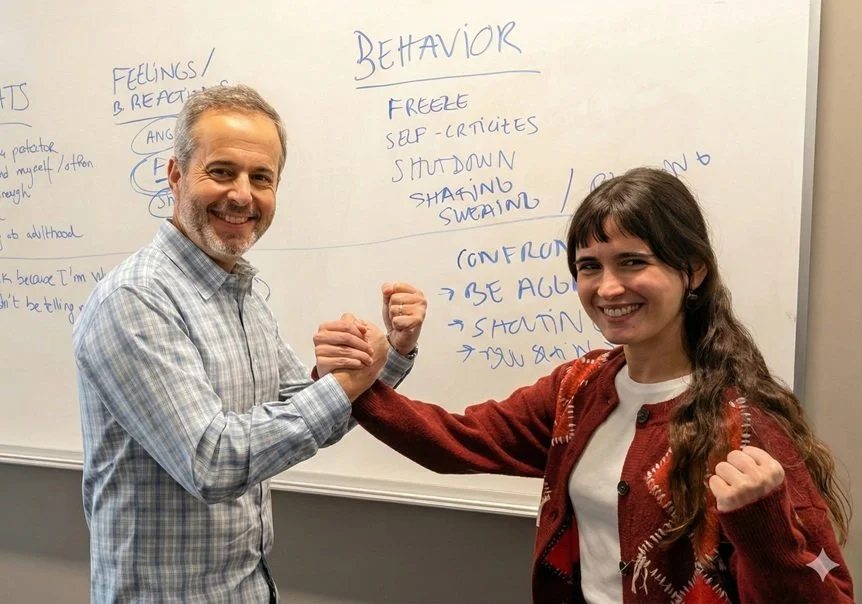
Tony Rousmaniere, PsyD is the President of Sentio University and Executive Director of the Sentio Counseling Center. He is Past-President of the psychotherapy division of the American Psychological Association and the author of over 20 books on deliberate practice and psychotherapy training, including The Essentials of Deliberate Practice book series (APA Books). He is a licensed psychologist in California and Washington. Learn more
Alexandre Vaz, PhD is the Chief Academic Officer of Sentio University and cofounder of the Deliberate Practice Institute. He is co-editor of The Essentials of Deliberate Practice book series (APA Books) and the author of over a dozen books on deliberate practice and psychotherapy training. Dr. Vaz is the founder and host of Psychotherapy Expert Talks. He is a licensed clinical psychologist in Portugal. Learn more