
AI Between Therapy Sessions: What a New APA Guide Means for Future Therapists
A Guide to AI Between Sessions for People Considering a Therapy Career
Therapy homework is the practice a client does between appointments: logging moods, scheduling rewarding activities, rehearsing a hard conversation, or facing a feared situation in small steps. Many clients now bring an AI chatbot into that space on their own. A Clinician's Guide to AI-Supported Therapy Homework: Ethical and Safe Use of AI Between Sessions, written by Alexandre Vaz and Tony Rousmaniere and published by the American Psychological Association, is a clinician's manual for bringing that use into therapy deliberately. The Kindle edition has a publication date of October 27, 2026, and the paperback a publication date of November 24, 2026 (Vaz and Rousmaniere, 2026). For students, the book previews a skill that matters for anyone who will see clients: knowing what clients do with AI, and how to make that use safer and more useful. Readers new to the profession can start with what an LMFT is and with the Sentio MFT program overview.
What Is Therapy Homework, and Why Does It Matter?
Homework is a standard part of cognitive behavior therapy and appears in many other approaches, including couple and family therapy (Dattilio, 2002). Between sessions a client might record thoughts and moods, schedule activities that bring a sense of accomplishment, practice a communication skill with a partner, or carry out an exposure exercise. The rationale is practical. Change has to show up in the client's life, and a weekly appointment is a small part of that life.
The research supports the rationale. A meta-analysis of 17 studies of cognitive behavior therapy, covering 2,312 clients, found that homework compliance was associated with better outcomes at the end of treatment (Hedges' g = 0.79 for the amount of homework completed) and at follow-up (g = 0.51). The same review found that the quality of the work clients did was related to outcome as well, which suggests that how well a client practices may matter alongside how often (Kazantzis et al., 2016).
Clients do not always complete the work. The new guide devotes a chapter to the problem, titled "The Problem With Therapy Homework: Why Clients Struggle With Between-Session Work," before turning to what AI can and cannot do about it. For a student, that chapter frames a practical question every clinician eventually faces: how to help a client keep practicing when the therapist is not in the room.
Are Clients Already Using AI for Mental Health Support?
Yes, and in large numbers. In February 2025, the Sentio AI Research Team surveyed 499 adults in the United States with ongoing mental health conditions who had previously used large language models. Nearly half, 48.7 percent, had used them for mental health support. Of those, 63 percent said the models improved their mental health, and 9 percent of participants reported at least one harmful or inappropriate response. Among the people who used the models for mental health support, 87 percent also had experience with human therapy, and 90 percent cited accessibility as a primary motivation (Rousmaniere et al., 2026).
What people describe doing with these tools overlaps with what therapists assign as homework. In a qualitative study of 243 written accounts from U.S. adults with ongoing mental health conditions who had used large language models in the past year, people described using them to vent, rehearse conversations, and seek perspective. They described help from concrete coping guidance, emotional support, and reframing, and harm from generic advice, risk-inducing guidance, and comforting language that felt hollow coming from a machine (Zhang et al., 2026).
Writing in The Lancet Psychiatry, Rousmaniere, Goldberg and Torous (2026) described large language models as already operating as a de facto frontline mental health resource, at a scale of millions of interactions per month, outside professional ethical codes, mandated reporting, and standardized evaluation. For a therapist, the practical consequence is simple. A client may be talking with a chatbot between sessions, with or without the therapist's knowledge.
What Does the Research Say About AI Between Sessions?
The early evidence points in two directions. A real-world observational study in five National Health Service Talking Therapies services in England compared 244 patients in group cognitive behavior therapy. Of these, 150 used a generative AI support tool for their between-session exercises and 94 used standard workbooks, with the same therapy content and the same human-led sessions. Patients using the AI tool attended more sessions, dropped out less often, and had higher rates of reliable improvement and recovery, and the benefit was related to how much they used the tool (Habicht et al., 2025). Because patients were not randomly assigned, the study shows an association and cannot establish that the tool caused the difference.
General-purpose chatbots also handle high-risk moments unevenly. When Sentio researchers and collaborators tested six widely used large language models against 180 standardized prompts simulating very high-risk mental health disclosures, none met basic clinical safety standards across all five criteria in the evaluation framework, and explicit acknowledgment of risk was the least consistent behavior (Santos et al., 2026). In a separate study of multi-turn conversations, an open-source model invited users to keep talking in only 14 percent of responses and became less likely to do so as users disclosed more suicide risk factors (Judd et al., 2026).
Read together, the findings suggest that AI between sessions can help clients do the work of therapy and that its risks call for a therapist's structure around it. The new guide is written to supply that structure.
What Does the New APA Guide Propose?
The book is written for practicing clinicians. It reviews the research on how and why clients turn to AI chatbots and what they get out of them, then translates those findings into practical guidelines and a set of overarching ethical principles for using the benefits of AI while limiting its risks. Allen Frances wrote the foreword (Vaz and Rousmaniere, 2026).
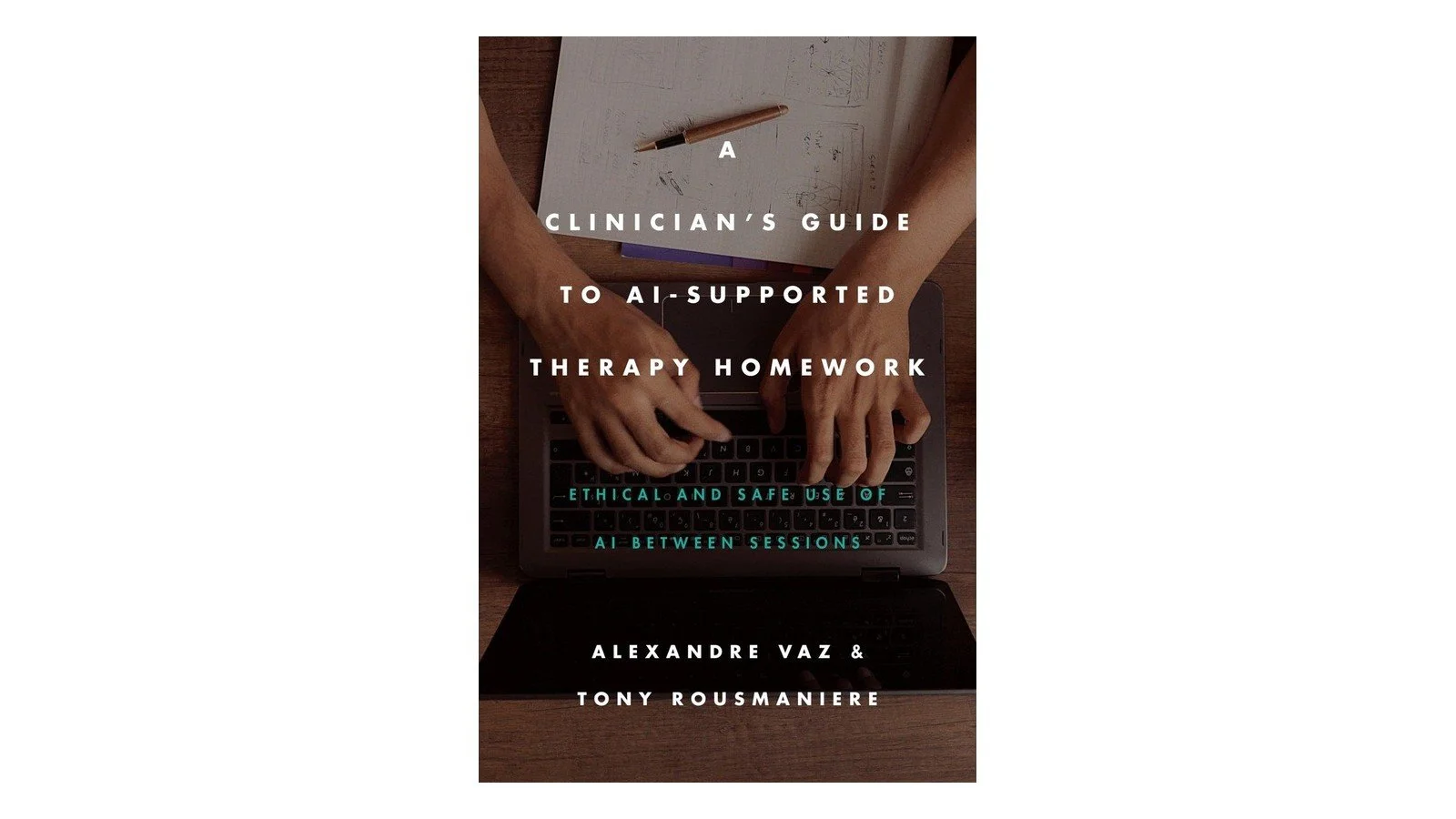
At the center of the book is a model of three roles that AI can play between sessions:
- Reinforcing motivation. AI helps the client stay engaged with the work agreed in session.
- Guiding task completion. AI walks the client through an assignment.
- Logging and reporting. AI records what the client did and generates a report to review in the next session.
Each application chapter breaks the process into five steps. The therapist introduces AI as a potential homework partner, sets boundaries that protect privacy and safety, and frames its use within the therapy. Therapist and client then codesign a simple, reusable prompt, with variations for the client's needs, and develop a clear plan for when and how the client will use it. The client reflects after using it. In the next session, the two review the results and integrate them into the treatment.
Eighteen chapters apply the model. Thirteen address clinical presentations: grounding and emotional regulation, mood tracking, behavioral activation and daily structure, relationship and communication skills, exposure and avoidance reduction, self-compassion, sleep hygiene, perfectionism, grief and bereavement, chronic pain, addiction recovery and habit change, exposure and response prevention for obsessive compulsive disorder, and worry and rumination in generalized anxiety disorder. Five address populations: couples using AI together, people living with chronic disability, autistic and neurodivergent clients rehearsing social communication, caregivers facing family burnout, and clients working toward vocational goals. Case examples follow realistic clients through the whole process.
Hanna Levenson, PhD, calls the book "essential reading for every practitioner, clinical supervisor, and trainee." The book can be ordered from the American Psychological Association, and it sits alongside the other books by Sentio faculty.
What Guardrails Does AI-Supported Homework Need?
Safety is built into the method. The first of the five steps sets boundaries to protect privacy and safety before any AI use begins, and the book reviews the ethical guardrails therapists can put in place, the challenges that commonly arise, and how to respond to them.
Two clinician checklists from the book are free to download. The Clinician Checklist: Assessment of Client AI Use covers what a client is already doing with AI. The Clinician Checklist: Appropriateness of AI Assistance Between Sessions supports the decision about whether AI-assisted homework fits a particular client. The American Psychological Association has also posted sample pages from the book.
The research on chatbot safety explains why the checklists matter. A tool can be helpful in one exchange and, in another, miss risk, withdraw from the conversation, or give generic advice to someone who needs something specific, as the Sentio safety studies found. A therapist who knows what the client is using, and for what, can decide whether that use belongs in the treatment plan and can review it in session.
In California, AI tools also sit inside a legal frame. Since January 1, 2026, the Business and Professions Code has barred developers and deployers of AI systems from using protected professional titles, or implying that a licensed person is providing the care, in the advertising or functionality of an AI system, as explained in AB 489 and AI in therapy.
What Does This Mean for Therapists in Training?
Students entering the field now will meet clients who already use chatbots, and some of those clients may not mention it unless asked. Three habits follow from the research and from the book's framework. The first is to ask about AI use as part of assessment, the way a clinician asks about sleep, substances, or social support. The second is to decide case by case whether AI-assisted homework fits a given client. The third is to keep anything a client does with AI connected to the goals of therapy by reviewing it in session.
None of this replaces the core of clinical training. The relational skills that depend on the therapist being a person are the hardest to automate, as discussed in AI and the future of therapy careers, and they are built through supervised practice. Knowing how clients use AI is part of that relational work, because it shapes what clients bring into the room. Students comparing programs can use the California MFT program directory to see how each school describes its training.
A Closer Look at One Program: The Sentio MFT Program
Sentio is one program among many. Students should research several and ask each one direct questions about how clinical skill is built and measured.
The Sentio MFT program, offered by a nonprofit graduate school based in Los Angeles with a hybrid delivery model that serves students throughout California, is a Master of Arts in Marriage and Family Therapy that meets the Board of Behavioral Sciences educational requirements for the LMFT. The program runs 20 months across 60 units at $1,120 per unit, with weekly online classes and one intensive in-person residency at the start of each semester, in cohorts capped at 24 students at a 4:1 student-to-faculty ratio. It is built on deliberate practice, and students complete practicum at the Sentio Counseling Center, the program's guaranteed practicum site, which provides more than 400 hours of supervised clinical experience.
Artificial intelligence is an area where the program does research as well as teaching, and its two co-founders wrote the new guide. Sentio runs an AI research team, publishes a statement on AI, and offers a free AI course for clinicians created by Alexandre Vaz. The authors' biographies published by the American Psychological Association describe the Sentio MFT program as the first MFT program approved by the California BBS for licensure to integrate deliberate practice and artificial intelligence into its curriculum.
Sentio is a small, newer institution, admits only applicants who are California residents or willing to relocate to California and who intend to license in California, and its alumni network is still developing. Prospective students weighing Sentio alongside larger or older programs should factor that into their decision. Learn more at the Sentio MFT program overview, the tuition and fees page, and the Sentio FAQ page.
Making Your Decision
If you are choosing a graduate program, ask what it teaches about AI, who teaches it, and whether its faculty publish research in the area. Ask how students learn to assess a client's AI use and how supervisors handle it during practicum. Program websites describe clinical training in similar language regardless of what is actually happening in classrooms and supervision rooms. Ask every program you are seriously considering whether you can attend a live or online class session before enrolling, and ask to speak with current students and recent graduates about how supervision and skill development function in practice. Reputable programs should welcome the request. Hesitation or refusal is informative on its own. Trust what you see in a classroom over what you read in promotional copy.
Frequently Asked Questions
What is AI-supported therapy homework?
It is between-session work in which a client uses an AI tool, such as a chatbot, to support an assignment agreed with their therapist. In the framework set out by Vaz and Rousmaniere (2026), AI plays one of three roles: reinforcing motivation, guiding the client through the task, or logging what the client did and generating a report for review in the next session.
Who wrote A Clinician's Guide to AI-Supported Therapy Homework?
Alexandre Vaz, PhD, and Tony Rousmaniere, PsyD, the co-founders of the Sentio MFT program, wrote the book, and Allen Frances wrote the foreword. The American Psychological Association publishes it.
When is the book available?
The Kindle edition has a publication date of October 27, 2026, and the 297-page paperback has a publication date of November 24, 2026. The paperback can be ordered from the American Psychological Association and from Amazon, and the Kindle edition from Amazon.
Does the book recommend using AI instead of therapy?
No. Its framework is designed to help clients use AI tools safely and effectively to enhance therapy, with each AI-supported assignment reviewed in the next session and integrated into the treatment.
Are there free resources from the book?
Yes. The American Psychological Association offers free sample pages and the book's two clinician checklists, Assessment of Client AI Use and Appropriateness of AI Assistance Between Sessions, as PDF downloads on the book's page.
Should therapists ask clients about AI use?
The book's first appendix is a clinician checklist for assessing a client's AI use. In a 2025 national survey of adults with ongoing mental health conditions who had used large language models, 48.7 percent had used them for mental health support (Rousmaniere et al., 2026), so many clients may already be using AI for problems they also bring to therapy.
Is AI support between sessions effective?
Early evidence is promising but limited. In an observational study in England's National Health Service, group therapy patients who used a generative AI support tool for between-session exercises attended more sessions and had higher recovery rates than patients using standard workbooks. Patients were not randomly assigned, so the study shows an association and cannot establish cause (Habicht et al., 2025).
References
Dattilio, F. M. (2002). Homework assignments in couple and family therapy. Journal of Clinical Psychology, 58(5), 535-547. https://doi.org/10.1002/jclp.10031
Habicht, J., Dina, L.-M., McFadyen, J., Stylianou, M., Harper, R., Hauser, T. U., & Rollwage, M. (2025). Generative AI-enabled therapy support tool for improved clinical outcomes and patient engagement in group therapy: Real-world observational study. Journal of Medical Internet Research, 27, e60435. https://doi.org/10.2196/60435
Judd, N., Vaz, A., Paeth, K., Davis, L. I., Esherick, M., Brand, J., Amaro, I., & Rousmaniere, T. (2026). Independent clinical evaluation of general-purpose LLM responses to signals of suicide risk. Proceedings of IASEAI Conference, 2(1), 279-292. https://ojs.aaai.org/index.php/IASEAI/article/view/43031
Kazantzis, N., Whittington, C., Zelencich, L., Kyrios, M., Norton, P. J., & Hofmann, S. G. (2016). Quantity and quality of homework compliance: A meta-analysis of relations with outcome in cognitive behavior therapy. Behavior Therapy, 47(5), 755-772. https://doi.org/10.1016/j.beth.2016.05.002
Rousmaniere, T., Goldberg, S. B., & Torous, J. (2026). Large language models as mental health providers. The Lancet Psychiatry, 13(1), 7-9. https://doi.org/10.1016/S2215-0366(25)00269-X
Rousmaniere, T., Zhang, Y., Li, X., & Shah, S. (2026). Large language models as mental health resources: Patterns of use in the United States. Practice Innovations, 11(2), 139-155. https://doi.org/10.1037/pri0000292
Santos, J. M., Shah, S., Gupta, A., Mann, A., Vaz, A., Caldwell, B. E., Scholz, R., Awad, P., Allemandi, R., Faust, D., Banka, H., & Rousmaniere, T. (2026). Evaluating the clinical safety of large language models in response to high-risk mental health disclosures. Practice Innovations. Advance online publication. https://doi.org/10.1037/pri0000316
Vaz, A., & Rousmaniere, T. (2026). A clinician's guide to AI-supported therapy homework: Ethical and safe use of AI between sessions. American Psychological Association. ISBN 978-1-4338-5031-8. https://www.apa.org/pubs/books/clinicians-guide-ai-supported-therapy-homework
Zhang, Y., Li, X., Zhu, J., Sheng, Z., & Rousmaniere, T. (2026). "What happens, what helps, what hurts": A qualitative analysis of user experiences with large language models for mental health support. Practice Innovations. Advance online publication. https://doi.org/10.1037/pri0000319