
How MFT Practicum Placement Works in California: Sites, Placement, and Why Students Struggle to Find One
A Guide to the Practicum Placement System
Every California MFT student must see real clients before graduating, and the place where that happens, the practicum site, is the part of a graduate program that the student can least control and that most often decides whether the degree finishes on schedule. The Business and Professions Code fixes the minimum practicum, requires the school to approve every site and hold a written agreement with it, and limits the kinds of settings a trainee may work in. Everything else, including who finds the site, how many hours the program demands, and how long the search takes, is set by the program, and the differences between programs are wide. This guide explains what the statute requires against what programs actually require, which sites take trainees, who is responsible for finding one, why sites have become hard to get and where the competition is heaviest, what trainees do once placed, and what to ask a program before enrolling. The legal status of the trainee is covered in what an MFT trainee is, the telehealth and online rules in whether you can complete your practicum online, and the placement questions to ask admissions in the placement section of how to evaluate a therapy graduate program in California. Sentio's own arrangement is described on the guaranteed practicum page.
What Is a Practicum, and How Does the BBS Minimum Compare With What Programs Require?
A practicum is the supervised clinical placement inside the degree in which a student, holding the legal status of trainee, counsels clients under a licensed supervisor while enrolled in a practicum course. Section 4980.36(d)(1)(B) of the Business and Professions Code sets the minimum: "A minimum of six semester or nine quarter units of practicum in a supervised clinical placement that provides supervised fieldwork experience," "A minimum of 150 hours of face-to-face experience counseling individuals, couples, families, or groups," and, in addition to the 150 hours, "75 hours of either of the following, or a combination thereof: (I) Client centered advocacy, as defined in Section 4980.03. (II) Face-to-face experience counseling individuals, couples, families, or groups" (California Legislature, 2026a). The statute also prescribes what the practicum must teach: "Applied use of theory and psychotherapeutic techniques," "Assessment, diagnosis, prognosis, and treatment planning," treatment of "individuals and premarital, couple, family, and child relationships, including trauma and abuse," "Professional writing, including documentation of services, treatment plans, and progress notes," and "How to connect people with resources that deliver the quality of services and support needed in the community" (California Legislature, 2026a). A student "must be enrolled in a practicum course while counseling clients," with the one exception of a gap in enrollment shorter than 90 days that is bracketed by practicum enrollment on both sides, which the Board calls the practicum bookends rule (California Legislature, 2026a; BBS, 2025a).
That is the floor, and almost no program stops there. The Board's own practicum FAQ notes that "Schools are permitted to set their own requirements for their program, including the gaining of hours, as long as those requirements do not interfere with requirements set in California law" (BBS, 2025a). The Commission on Accreditation for Marriage and Family Therapy Education requires accredited master's programs to have students "acquire a minimum of 300 direct clinical contact hours with individuals, couples, families, or other systems, at least 100 of which must be relational hours that occur over a minimum of twelve months of clinical practice," together with at least 100 hours of supervision, 50 of them "utilizing observable data" (COAMFTE, 2021). Individual California programs publish their own figures. San Diego State's MFT program requires "a minimum of 300 direct clinical contact hours," 100 of them relational, plus 100 supervision hours of which 50 must be live (San Diego State University, 2026). UMass Global's clinical handbook requires 300 direct client contact hours within 400 total practicum hours (UMass Global, 2024). Touro University Worldwide requires "300 Total Practicum Client Contact Hours," 100 relational (Touro University Worldwide, n.d.). California State University, Northridge sets the highest published figure among the programs checked for this guide: a "600 Hours Fieldwork Requirement = Minimum of 500 Clinical Hours and 100 Supervision Hours," with at least 100 relational hours (California State University, Northridge, 2026). Sentio guarantees "over 400 hours of clinical experience that can be counted toward licensure in California" (Sentio University, 2026a). The BBS counts a trainee's hours toward the 3,000-hour license requirement up to 1,300 pre-degree hours, no more than 750 of them counseling and supervision combined; the arithmetic is in the 3,000-hour guide.
What Kinds of Sites Take Trainees?
Any setting that meets three statutory tests, except a private practice or a professional corporation. The Board's FAQ for trainees states the tests in one place: "All Trainee work settings must comply with all of the following: The school in which the Trainee is enrolled must approve the site and have a written agreement with the site that details each party's responsibilities. The setting must lawfully and regularly provide mental health counseling or psychotherapy. The setting must provide oversight to ensure that the Trainee's work at the setting meets the experience and supervision requirements and is within the scope of practice for the profession" (BBS, 2025b). The same FAQ adds that "Trainees are prohibited from working in a private practice or professional corporation setting until they have been issued an Associate registration," and it defines a private practice as one owned by a licensed health professional who provides clinical mental health services and sets the conditions of client payment (BBS, 2025b). Section 4980.43.3(b) puts the prohibition in statute (California Legislature, 2026b).
In practice the sites fall into a few types. Community mental health agencies and nonprofit counseling centers are one type; Pepperdine's clinical training team, for example, "develops and maintains strong relationships with approved mental health agencies all over Southern California in order to provide traineeship opportunities to students in the program" (Pepperdine University, 2026a). University-run training clinics are the second type: San Diego State's students begin at the program's own Center for Community Counseling and Engagement "during the first fall and spring semester" before moving to community traineeship agencies (San Diego State University, 2026), and Sentio's students train at the Sentio Counseling Center, a nonprofit clinic affiliated with the university (Sentio University, 2026a). Schools and school districts are a third type, and some programs are built around them, such as Cal State LA's Master of Science in Counseling with an option in School-Based Family Counseling (Sentio University, 2026b); the setting is described in school-based MFT careers in California. Government agencies, hospitals, and residential programs that lawfully and regularly provide psychotherapy qualify on the same tests. The Board's term for the settings outside private practice is an exempt setting, "a governmental entity, a school, a college, a university, or an institution that is both nonprofit and charitable (designated as a '501(c)(3)' by the Internal Revenue Service)" (BBS, 2025b), and the trainee at any of them works as "a W-2 employee or as a volunteer" (BBS, 2024) and may not take payment from clients (California Legislature, 2026b).
Who Finds the Site, the Program or the Student?
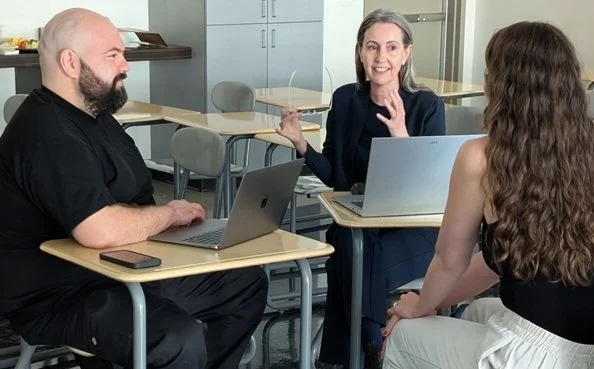
The statute answers only half of the question. Section 4980.42(e) requires that "all hours of experience gained as a trainee shall be coordinated between the school and the site where the hours are being accrued. The school shall approve each site and shall have a written agreement with each site that details each party's responsibilities, including the methods by which supervision shall be provided" (California Legislature, 2026c). The school must therefore approve and contract with every site. Whether the school also locates the site for the student is left to the program, and programs answer it three ways.
In the first model the student finds the site from an approved list. Northridge's handbook states that "Students are required to interview for and acquire an approved fieldwork placement," that "Students must apply for and locate a site from the approved list on the cohort Canvas page," and, without qualification, that "Each student must find their own placement" (California State University, Northridge, 2026). UMass Global's handbook states that "It is the student's responsibility to secure a practicum site and to reach out to CFR as needed for support," and warns that "Students are discouraged from interviewing at non-approved agencies, as approvals are contingent and not guaranteed" (UMass Global, 2024). Touro University Worldwide states that "TUW is not responsible for finding the Clinical Placement site and/or agency for students. The student is responsible for identifying the Clinical Placement site to arrange a formal interview of the student," and that training may begin "only after TUW Coordinator of the Practicum Training has approved the Clinical Placement site and signed an MOA Agreement with the site" (Touro University Worldwide, n.d.). In this model the student carries the search, the interviews, and the risk of a late start.
In the second model the program assists. Pepperdine's clinical training staff "assist students in locating Pepperdine-approved clinical practicum sites," visit and evaluate sites, and maintain a Field Placement Directory of approved sites on Handshake (Pepperdine University, 2026b). San Diego State runs the first-year practicum at its own clinic and maintains a list of community agencies for the traineeship that follows (San Diego State University, 2026). Assistance shortens the search; it does not transfer the risk, because the student still applies and interviews at agencies that decide for themselves whom to take.
In the third model the program guarantees the placement. Sentio's published commitment is that "Sentio MFT students get guarantee practicum placement into the Sentio Counseling Center (SCC), an online practicum site that specializes in serving clients with trauma" (Sentio University, 2026a). A guarantee is only as good as the document it appears in; the placement section of how to evaluate a therapy graduate program explains why the commitment should appear in the enrollment agreement rather than the brochure.
Why Is Finding a Site Hard, and Where Is It Hardest?
Because a site gives up more than it gets. To host one trainee, an agency must assign a supervisor who has been licensed for two of the last five years and has completed the Board's supervisor training, provide at least one hour of that supervisor's time for every five hours the trainee counsels each week, sign the school's agreement, produce progress reports, and take on a clinician who may not accept payment from clients and who will leave when the degree ends (California Legislature, 2026b, 2026c, 2026d, 2026f). Chris Hoff, the executive director and clinical director of the California Family Institute in Costa Mesa, described the result in February 2026: "Every week, it seems, another university counseling program is reaching out...asking if we can take their students for practicum. Programs that used to have waiting lists of sites are scrambling to place students" (Hoff, 2026). He attributed the squeeze to expanding graduate enrollment on one side and shrinking agency capacity on the other, with community clinics facing the loss of federal mental health grants in January 2026 and insurance reimbursement rates that "average 22% lower than medical visits," and he put the cost plainly: supervising a practicum student means "licensed clinicians spending billable hours in supervision" (Hoff, 2026).
The competition is heaviest where programs cluster. Counting each of the 76 programs in Sentio's directory once, by the first California campus named on its review page, 18 are in Los Angeles County, 11 in Orange County, and 18 in the San Francisco Bay Area, so 47 of the state's 76 programs draw on the agencies of two metropolitan regions, and their students apply to the same sites in the same months (Sentio University, 2026b). Timing compounds the geography. Pepperdine warns that "Many of our clinical practicum sites only offer supervision and clinical counseling hours during weekdays" (Pepperdine University, 2026b), so a working student competes for a smaller set of evening placements, and a placement that ends mid-program stops the hours until a new site is approved and contracted; if the student's practicum enrollment lapses for 90 days or more in the meantime, "the Trainee cannot count any hours gained during that time period" (BBS, 2025b). The experience shows up in students' own accounts; the site's review of what students report includes a Reddit post from an MFT student who could not find a practicum site (Sentio University, 2026c). The cost of the search is measured in semesters: each term without a placement is tuition paid without clinical hours earned, and the supervised hours that follow the degree start later.
What Do Trainees Do at a Site?
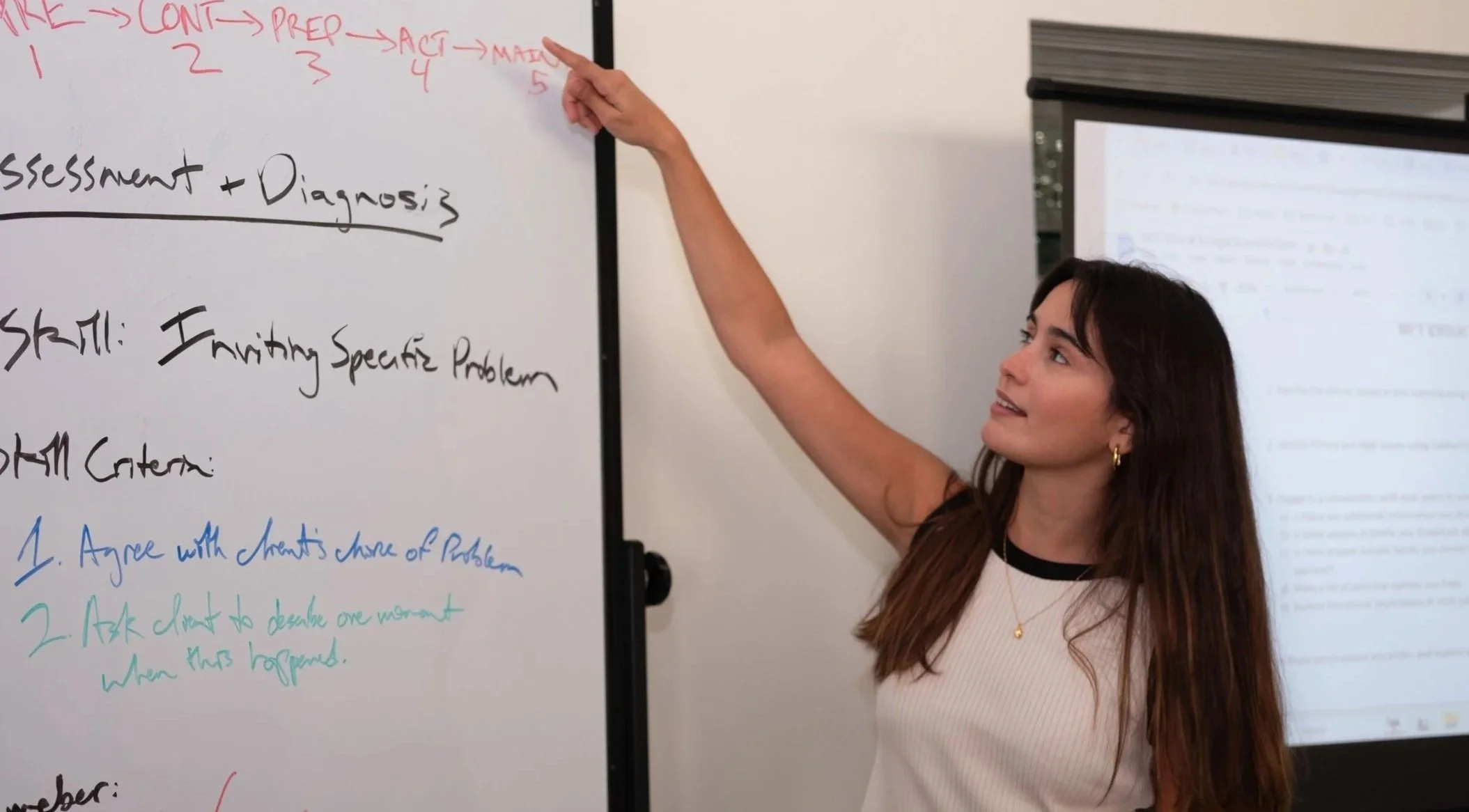
They see clients, write about them, and are supervised on them, in a schedule the program sets. Northridge and San Diego State both describe field placements of "15-25 hours per week" (California State University, Northridge, 2026; San Diego State University, 2026); San Diego State's first-year practicum at its own clinic runs about five hours a week and is unpaid (San Diego State University, 2026). Within those hours the statute's five training areas apply: theory and technique in session, assessment and diagnosis and treatment planning, treatment of individuals and of couple, family, and child relationships including trauma and abuse, documentation in treatment plans and progress notes, and connecting clients with community resources (California Legislature, 2026a). Before any session, section 4980.48 requires the trainee to tell the client that they are an unlicensed marriage and family therapist trainee, name the employer, and say who supervises them (California Legislature, 2026e). Each week in each setting the trainee receives at least one hour of direct supervisor contact, and on average one hour for every five hours of counseling (California Legislature, 2026d); the supervision rules are set out in BBS supervision requirements. Telehealth sessions count toward licensure hours and, when they include both audio and video, toward the 150 face-to-face practicum hours; telephone-only sessions count toward licensure but not toward the 150 (BBS, 2025b). Hours beyond the practicum minimum, up to the 1,300 pre-degree cap, are logged on the Board's weekly forms and carried into the associate period after graduation.
What the hours contain matters more than the count. A 2025 survey of 234 students in practicum or internship courses at accredited programs, summarized in clinical preparation in MFT training, found that students who had practiced interventions in structured exercises, observed experienced therapists, and received specific corrective feedback reported the greatest confidence in real clinical work, and that only about a third rated their program's help as substantial across all six AAMFT competency domains. Sites differ in whether sessions are recorded, whether supervisors watch the recordings, and whether clients complete outcome measures; how to evaluate MFT supervision quality gives the questions that expose those differences.
What Should You Ask a Program About Placement Before Enrolling?
Seven questions, each answerable from a document. First, which model: does the program guarantee a placement, assist with one, or hand over a list, and where is that commitment written? Second, which sites hold current written agreements with the program under section 4980.42(e), and how many trainees did each take last year? Third, when does practicum begin, in the second term, as at Pepperdine, in the first fall at a university clinic, as at San Diego State, or in the second year, as at Northridge, and what happens to a student who has not been placed by then (Pepperdine University, 2026a; San Diego State University, 2026; California State University, Northridge, 2026)? Fourth, how many client contact hours does the degree require, the statute's 150 plus 75 or a program figure of 300, 400, or 500, and over how many months? Fifth, how many hours a week does the placement expect, on what days, and can a student who works keep the schedule? Sixth, who supervises at each site, what are their licenses and years since licensure, and does supervision use recordings or live observation? Seventh, what was the average time from practicum eligibility to a first client for the most recent cohort? The four questions in the placement section of how to evaluate a therapy graduate program cover the same ground from the admissions side. The directory of California MFT programs records the practicum arrangements each program publishes.
A Closer Look at One Program: Sentio University's MFT Track
The following description of one specific MFT program is offered as a concrete example of how a program can handle placement, not as a recommendation against evaluating other programs. Students should research multiple options and ask each one direct questions about how clinical skill is built and measured.
Sentio University, a nonprofit graduate school based in Los Angeles with a hybrid delivery model that serves students throughout California, offers a Master of Arts in Marriage and Family Therapy that meets the Board of Behavioral Sciences educational requirements for the LMFT. The program runs 20 months across 60 units, with weekly online classes and one intensive in-person residency at the start of each semester, in cohorts capped at 24 students at a 4:1 student-to-faculty ratio. It is designed around deliberate practice methodology and is described in peer-reviewed work as the first graduate psychotherapy program to thoroughly integrate deliberate practice, with roughly half of nearly every class session dedicated to active skills training rather than lecture (Rousmaniere and Vaz, 2025, p. 2). Supervisors at Sentio are trained through a video-based supervision training program (Rousmaniere and Vaz, 2025, p. 2) that now runs in six- and twelve-month tracks.
On placement, Sentio uses the third model. Every student is guaranteed a practicum placement at the affiliated Sentio Counseling Center, a nonprofit clinic that is not a private practice, with over 400 hours of clinical experience that count toward California licensure (Sentio University, 2026a); the site search that section 4980.42 leaves to the school and the student is settled at admission, and the written agreement the statute requires is between the university and its own clinic. At the Center every session is video-recorded, every client completes routine outcome measures at every session, and supervision follows the Sentio Supervision Model, a peer-reviewed protocol that integrates outcome monitoring, video review, and deliberate practice rehearsal into the supervision hour (Brand, Miller-Bottome, Vaz, and Rousmaniere, 2025). Because years of clinical experience bear little relation to therapist effectiveness in the research literature (Vaz and Rousmaniere, 2022, p. 3), the program treats the practicum as the place where habits of video review and outcome monitoring are formed rather than as an hour count. Sentio also integrates AI literacy training through its AI certification program for therapists.
Sentio is a small, newer institution, admits only applicants who are California residents or willing to relocate to California and who intend to license in California, and its alumni network is still developing. Prospective students weighing Sentio alongside larger or older programs should factor that into their decision. Learn more at the Sentio MFT program overview, the tuition and fees page, and the Sentio FAQ page.
Making Your Decision
The practicum is the one part of a California MFT degree that a program cannot deliver alone: it depends on an outside agency, or a clinic of the program's own, agreeing in writing to supervise a student for months at the agency's expense. The statute fixes what the placement must contain and requires the school to approve and contract for it; it leaves the search itself to the program's policy, and that policy is the single largest difference between programs that look alike on paper. Read the placement policy in the handbook and the enrollment agreement before reading anything in the brochure, and weigh a guarantee, a placement office, and a list of sites as three different products at three different levels of risk. Program websites describe clinical training in similar language regardless of what is actually happening in classrooms and supervision rooms. Ask every program you are seriously considering whether you can attend a live or online class session before enrolling, and ask to speak with current students and recent graduates about how supervision and skill development function in practice. Reputable programs should welcome the request. Hesitation or refusal is informative on its own. Trust what you see in a classroom over what you read in promotional copy.
Frequently Asked Questions
How many practicum hours does California require for the MFT degree?
Section 4980.36 requires at least six semester units of practicum with a minimum of 150 hours of face-to-face counseling and 75 additional hours of counseling or client-centered advocacy, 225 hours in all. Programs set their own higher figures; COAMFTE-accredited programs require at least 300 direct client contact hours, and some California programs require 500.
Does the school find my practicum site, or do I?
The law requires the school to approve every site and hold a written agreement with it, but it does not say who finds the site. Some programs require students to locate and secure a placement from an approved list, some assist through a placement office and site directory, and a few guarantee a placement. The program's handbook and enrollment agreement state which model applies.
Can a trainee do practicum in a private practice?
No. Section 4980.43.3 and the Board's FAQ prohibit trainees from working in a private practice or professional corporation until an associate registration is issued. Trainee sites must lawfully and regularly provide mental health counseling or psychotherapy, provide oversight, and hold a written agreement with the school; community agencies, university clinics, schools, government agencies, and nonprofit organizations qualify.
Why is it so hard to find a practicum site in California?
Hosting a trainee costs a site supervisor time, paperwork, and oversight, and the trainee may not accept payment from clients. In February 2026 a California clinical director documented programs that once kept waiting lists of sites now scrambling to place students, as graduate enrollment grew and community clinics faced funding cuts. Competition is heaviest in Los Angeles, Orange County, and the Bay Area, where 47 of the state's 76 programs are based.
Are practicum trainees paid?
Trainees may work only as W-2 employees or volunteers and may not accept payment from clients. Many practicum placements are unpaid; San Diego State, for example, states that its first-year practicum is not paid. Whether a site pays is a question to ask each program and site directly.
Do telehealth sessions count toward the practicum?
Yes, with one limit. The Board's FAQ states that trainees may gain experience hours through telehealth, including by telephone, but the 150 face-to-face practicum hours require both audio and visual contact with the client, so telephone-only sessions count toward licensure hours and not toward the 150.
What happens if my practicum placement falls through?
A trainee must be enrolled in a practicum course to counsel clients, with one exception: a gap in enrollment shorter than 90 days that is immediately preceded by practicum enrollment and immediately followed by re-enrollment or completion of the degree. If the gap reaches 90 days, no hours earned during it count. Ask each program what it does for a student whose site ends mid-term.
What should I ask a program about practicum placement before I enroll?
Whether the program guarantees, assists with, or leaves the placement to the student, and where that commitment is written; which sites hold current agreements and how many trainees each took last year; when practicum begins and what happens if a student is not yet placed; how many client contact hours the degree requires and over how many months; the weekly schedule; who supervises and how; and the most recent cohort's average time from practicum eligibility to a first client.
References
Brand, J., Miller-Bottome, M., Vaz, A., and Rousmaniere, T. (2025). Deliberate practice supervision in action: The Sentio Supervision Model. Journal of Clinical Psychology, 1-11. https://doi.org/10.1002/jclp.23790
California Board of Behavioral Sciences. (2024). Handbook for Future LMFTs. https://www.bbs.ca.gov/pdf/publications/lmft_handbook.pdf
California Board of Behavioral Sciences. (2025a). MFT trainees: Practicum course requirements. https://www.bbs.ca.gov/pdf/publications/practicum_requirements_faq.pdf
California Board of Behavioral Sciences. (2025b). Answers to most frequently asked questions relating to MFT trainees and AMFTs (revised February 2025). https://www.bbs.ca.gov/pdf/publications/mft_faq.pdf
California Legislature. (2026a). Business and Professions Code section 4980.36. https://leginfo.legislature.ca.gov/faces/codes_displaySection.xhtml?lawCode=BPC§ionNum=4980.36.
California Legislature. (2026b). Business and Professions Code section 4980.43.3. https://leginfo.legislature.ca.gov/faces/codes_displaySection.xhtml?lawCode=BPC§ionNum=4980.43.3.
California Legislature. (2026c). Business and Professions Code section 4980.42. https://leginfo.legislature.ca.gov/faces/codes_displaySection.xhtml?lawCode=BPC§ionNum=4980.42.
California Legislature. (2026d). Business and Professions Code section 4980.43.2. https://leginfo.legislature.ca.gov/faces/codes_displaySection.xhtml?lawCode=BPC§ionNum=4980.43.2.
California Legislature. (2026e). Business and Professions Code section 4980.48. https://leginfo.legislature.ca.gov/faces/codes_displaySection.xhtml?lawCode=BPC§ionNum=4980.48.
California Legislature. (2026f). Business and Professions Code section 4980.03. https://leginfo.legislature.ca.gov/faces/codes_displaySection.xhtml?lawCode=BPC§ionNum=4980.03.
California State University, Northridge. (2026). Marriage and Family Therapy program handbook. https://www.csun.edu/eisner-education/educational-psychology-counseling/programs/mft-handbook
Commission on Accreditation for Marriage and Family Therapy Education. (2021). Accreditation standards, version 12.5. https://www.coamfte.org/Common/Uploaded%20files/COAMFTE/Accreditation%20Resources/COAMFTE%20Standards%20Version%2012.5%20-%20Published%20August%202021%20-%208.26.21%20(with%20links).pdf
Hoff, C. (2026, February 1). The practicum site crisis nobody's talking about. Liminal Lab. https://chrishoff.substack.com/p/the-practicum-site-crisis-nobodys
Pepperdine University. (2026a). MACLP practicum preparation (on-ground campuses). https://gsep.pepperdine.edu/masters-clinical-psychology-mft-day/practicum/
Pepperdine University. (2026b). MA in Clinical Psychology (evening format): FAQs. https://gsep.pepperdine.edu/masters-clinical-psychology-mft-evening/faq/
Rousmaniere, T., and Vaz, A. (2025, March). Sentio's clinic-to-classroom method: Bridging deliberate practice and clinical training. Psychotherapy Bulletin, 60(2), 79-84. https://societyforpsychotherapy.org/sentios-clinic-to-classroom-methodbridging-deliberate-practice-and-clinical-training/
San Diego State University. (2026). Marriage and Family Therapy M.S.: Frequently asked questions. https://education.sdsu.edu/graduate/marriage-family-therapy-ms/faq
Sentio University. (2026a). Guaranteed practicum at the Sentio Counseling Center. https://sentio.org/guaranteed-practicum-at-sentio-counseling-center
Sentio University. (2026b). California MFT programs: The directory. https://sentio.org/mft-programs-in-california
Sentio University. (2026c). Is your MFT program actually teaching therapy? https://sentio.org/blog/is-your-mft-program-teaching-therapy
Touro University Worldwide. (n.d.). Degree completion requirements for the MFT degree. https://www.tuw.edu/wp-content/uploads/MFT%20Degree%20Completion%20requirements.pdf
UMass Global. (2024). Master of Arts in Marriage and Family Therapy clinical handbook 2024-2025. https://www.umassglobal.edu/sites/default/files/documents/admissiondocuments/ma-mft-clinical-handbook-202425-v3.pdf
Vaz, A., and Rousmaniere, T. (2022). Clarifying deliberate practice for mental health training. Sentio University. https://drive.google.com/file/d/1MFdWU-fRl-2EKN2rdvFsExPcJ8-O0C_A/view